Showing posts with label retirement. Show all posts

Friday, 9 March 2018

Early Retirement vs Semi-Retirement

Early Retirement
A study conducted by Melbourne University shows that after working for intense long hours will cause brain damage. For workers age 40 years old and above, the ideal number of working days should be just 3 days per week. This will keep the brain active yet will not over exert oneself due to undue stresses.

Seriously, who does not want to work just 3 days a week? I always believe in there is a price to everything. If you work for 3 days a week, I will think this is considered a form of part time work or sharing of work. Part time work can be considered as a subset of semi-retirement. Be it semi-retirement or early retirement, you need to be financially and psychologically prepared. Before you think about early retirement, you need to envisage what sort of lifestyle you want to live when you are retired. With this in mind, then you can work backwards to decide what is to be done to get you there.

Step 1 - Set your retirement goals. When will you like to retire? At what age, will you like to retire? How long will you be retired for? During your retirement, what sort of monthly income or draw down from savings will be required?

Step 2 - You need to work out your personal balance sheet to understand your personal assets and personal liabilities. You can also make use of CPF retirement calculator or some of the online retirement calculator tools to make some simplify forecast and estimation. You can also determine the differences to make up for in order to achieve your retirement goal.

Step 3 - If there is no gap to fill, congratulations, you are well prepared for retirement. If not, proceed to Step 4.

Step 4 - You may want to increase your time frame for wealth accumulation, delaying your retirement age.

Step 5 - You may want to reduce your post retirement monthly income or draw down amount per month.

Step 6 - Reduce your present monthly expenses to increase your monthly savings.

Step 7 - Increase the rate of return of your investment. Remember higher return comes with higher risk.

Most of the people feels that to retire is to stop all forms of work, they will depend on their passive income to maintain their lifestyle to enjoy the finer things in life. If your definition of early retirement is to lead a more prudent lifestyle, reducing your expenses which is more practical and sustainable.

Semi-Retirement
Most of us in their mid-life will strive to have work life balance to have more quality time with the family. I am sure you too will like to have early retirement. The age group between 40 - 50 years old will be commanding the highest income level during their working lifetime. However, this is the age group where their family expenses will be  highest as well due to children education, ageing parents and home mortgages.

If you will like to maintain a certain level of lifestyle and your savings cannot last for the entire duration, you can consider another form of retirement. You can find a part time job to keep yourself active while maintaining your lifestyle.

Many Singaporeans are over dependent on their CPF as the main source of retirement fund. However, you can only draw down after an age of 65 years old. If you wish to retire before 65 years old, then you need to have other source of income.

For early retirement and semi-retirement, the expense will be at a similar level compared to your working days. Early retirement is to enjoy the same level of lifestyle, usually people will not reduce their expenses. In the worse case scenario, it will be even higher than before.

In order to retire earlier, you need to do the following:

1) Be very thrifty
2) Invest alot

When it comes to investment, do not have a gambling mentality in order to make money in the shortest time, thinking this will allow you to retire earlier. What if you are wrong? This will set you back in terms of your retirement fund and retirement age.

If you are 40 years old this year and will like to retire at 55 years old, you have 15 years to save and invest to lead the retirement life you desire. If you have already accumulated sufficient CPF, you can consider contributing to your CPF voluntarily to earn a higher interest and reduce your taxes.

3 Tips towards Semi-Retirement
1) Ensure that you have sufficient savings to cater for retired lifestyle. A part time job will have lesser income than your full time job. You can depend on your part time job to save up on your retirement fund.

2) Part time employee may not have health and medical benefit, you need to ensure that you have sufficient health and medical insurances. A drastic medical event may wipe out your retirement fund if you are adequately covered by insurance.

3) Part time income may not be stable and as high as full time employment. Therefore you need to change your spending habits. For example, cook your own meals or eat mixed vegetables rice instead of going to posh restaurants.


Wednesday, 18 October 2017

SRS can help to reduce Tax and increase Investment

SRS represents Supplementary Retirement Scheme was introduced in 2001 but not alot people are familiar with it By putting your money in SRS, you can use it to offset your taxes and the money can be used for investment. It is a win and win. Reduce tax and increase your money. Seems like a no brainer deal, I will explain the pros and the cons. Then you evaluate whether this tool is suitable for yourself.

According to statistics from the SG government, there are only 127,753 SRS accounts in Singapore based on end of 2016. It is not even close to 10% of the tax paying population. 

The greatest advantage of SRS is the ability to reduce taxable income. Maximum annual contribution of S$15,300 for Singaporeans and PRs, and S$35,700 for Foreigners. Upon reaching the retirement age, you can use 10 years to withdraw the money in SRS account. You will be to be taxed based on half the amount you withdraw. How does this benefit you then? For example, if you deposit $10,000 into your SRS account this year. For the next taxable year, your taxable income will be reduced by $10,000. If the original taxable income is $50,000 it will now be reduced to $40,000. See below image which I extract from DBS website for illustration purpose.

Note: This is not an advertisement. I am not paid by DBS for this.

After 62 years old, if you withdraw S$40,000 each year, the taxable amount is S$20,000. However in Singapore, taxable income is $20,000 and above. Hence, you do not need to pay any tax. So S$40,000 x 10 years = $400,000 for the SRS account. This is the target amount you want to reach and you will not be subjected to any taxes. Do note, if you withdraw a lumpsum more than S$40,000 in a single year, your tax can be considerably high.

What if I withdraw before 62 years old?

You can withdraw from SRS account before the age of 62 years old but you will be subjected to penalty of 5% and your full withdrawal amount will be taxable (not half of it will be taxed!). 

Awas! Therefore you need to weigh this, whether you want to lock your money for 20-30 years just for the sake of tax reduction. Utilise SRS account only when you don't need this amount of money. You will only see it after 62 years old. Boy, where will I be then? Will I be in the graves?

The nature of SRS account is more well received by the middle-aged group. Ages between 46 - 55 years old represents 33% of the SRS accounts. The 2nd largest group is from 36 - 45 years old, they represents between 29% - 31%. 

This is not surprising because those in 40+ years old should reach the highest income bracket group. SRS helps the high income group to reduce their taxes. Furthermore, a 30 years old guy will need to wait for 32 years before he can utilise the money from SRS account. Hence, condo price drops to S$500 psf and you cannot use the money to buy it. It will be an opportunity loss. Whereas a 50 years old man just need to wait for another 12 year in order to withdraw from SRS account.

Use SRS account as a tool for Retirement Planning
You can open an account with 3 local banks DBS, OCBC and UOB to enjoy the benefit of tax savings.

1. Try to put in the maximum amount. For now it is S$15,300.
2. Plan to cap it at S$400,000. Pace yourself to reach that amount. Nothing more nothing less. In future, this amount may increase based on inflation requirement.
3. Invest to increase your return.

See below image from DBS for further illustration. This is based on above example, if you place S$10,000 per annum in SRS for the next 27 years.


I will beg to differ for the Balanced portfolio as DBS is trying to sell you Unit Trusts. In short, if you park your money there and do nothing, you will get S$270k. If you take a balanced approach, you can achieve about S$388k. If you are aggressive and put in stocks, you can get S$489k. 4% per annum is average return over 27 years.

SRS account can be used for fixed deposit, single premium product, equities, REITs, Unit Trust, Bond, etc.

Annual Income lesser than S$40k will benefit less 
In order to benefit from SRS account, your taxable income needs to achieve a certain level of comfort. In Singapore, the tax system is a progressive approach in different tax bracket. SRS serves to bring down the taxable income to a lower tax bracket. 

For example, if a guy has an income of S$90,000. Without SRS, first S$80,000 will be subjected to a tax of S$3,350. The rest of S$10,000 will be subjected to S$1,150 which is 11.5%. Total tax is S$4,500.

If he pumped S$15,300 and his taxable income is reduced to S$74,700. His tax bracket is shifted down by one level. The first S$40,000 will be subjected to tax S$550. The remaining S$34,700 will be subjected to 7% tax which is S$2429. Total tax is S$2979. This means a saving amount of S$1521 which is equivalent to 34% tax savings.

Cons

1) SRS is not flexible
Remember the penalty upon early withdrawal. The full amount will be subjected to taxes.

2) You see the money but you cannot touch
Similar to Special Account in your CPF. I do not need to add more to explain.

3) Do leave your money in SRS and not do anything to it
If you leave it there as Fixed Deposit, you make only 0.1% interest. This is losing money to inflation. You need to put it to use. Put it in equities or give me the money.

Saturday, 14 October 2017

Alpha Lab Investment Mastermind Group and Revelation

What do you do after work and during your free time determines how successful you will become in life. A few friends who are interested in investing came together on a Saturday afternoon to discuss individual investment approach, circle of competence and various stocks we are interested in. It has been very insightful and always refreshing to meet like-minded friends.

Going forward, we are going to share our individual research so that we can gain access to more good stocks. This can help us expand our warchest of ideas. Then when the opportunity presents itself, we can utilise our warchest of money to respective stocks.

After the event, I had dinner with my friend to catch up on his latest business endeavors. I shared with him our family project which is for my wife to retire in 4 years time. He pointed out that this should not be the goal post but I should look into the definition of financial freedom. 

Financial Freedom is when your passive income exceeds your expenses. 

I explained that my active income from Options Trading has reached about USD 2,500 and I hope to replace my work income so that I can stop working for someone. He reminded me of the original definition of Financial Freedom, I should work on getting the Options Trading income to exceed my total expenses instead.

I came home and reworked my household Cashflow Statement.

Total Monthly Cash Outflow S$6,207

Rental Income S$400
Dividend Income S$3,333 (Assume I deploy S$1m and just 4% yield)
Option Income S$3,712
Total Monthly Alternative Income Inflow S$7,445.83 

Damnit! We are already FINANCIALLY FREE! What a revelation!

Then I should be asking myself what I should be pursuing next - my passion. Recently, I am reading Ray Dalio - Principles and his definition of Work is to do something that you enjoy and be paid for it. Also, who you choose to work with and spend time together at work will determine your happiness.  

*Disclaimer - Option Income needs to be stable at this level. Losses will disturb this equilibrium. At the end, it is still active income. You can consider this as money you put in your Opportunistic Fund.

After thinking through, I will not just throw in my resignation letter on Monday, I will wait at least a few more months to make sure my Options Income can be stable and need to test a crisis model on JC Options Fund.

20/10/2017
Last night, I met up with my trusted financial planner friend. He felt that my definition of Financial Freedom has some room for errors. He thinks that as a family man, my expense is still fluctuating and there is a strong likelihood that it will increase in the near future. This depends on whether I will send my children to enrichment classes and tuition.  His advise is Financial Freedom is not the end goal but the journey matters more. 

His advise is continue to work hard, we are too young to retire, do what you believe in and increase your income level to cater for unexpected situations. 

He showed me his trade of 200 contracts of MOS SP 22. That is USD 440,000! He has many multi-baggers. Wow, the session humbled me. Stay humble, stay foolish, stay hungry!

Tuesday, 29 August 2017

Financial Consultation for my colleague


Last Friday, my colleague asked me for some advise as she felt stuck in her situation. She wanted a career opportunity with increment and annual bonus. However, I shared with her this is the riskiest choice as she is risking for a 3% increment each year when the boss is able to give her the golden handshake. I am not saying my boss will do that but he can do that. So why let your boss determine your livelihood? She is interested in how I make money while I am sleeping (according to her theory). This is slightly exaggerated but I tried to explain to her the theory of cash flow.

From the above image, if you can save $500/month which is $6,000/ year, she can generate a 4% return every year, compounded till she is 65 years, her initial capital inject of $168k will double to $324k. 

I explained to her on the differences between the Poor, the Middle Class and the Rich.

The Poor - Their income comes in at the end of the month and it will immediately goes into their expenses. They will spend all of them and sometimes spend even more than what they earn using credit cards.

The Middle Class - They use their income to gather more Liabilities. Liabilities are things that take money out of your pocket. For example, when you buy a property, you may perceive it as asset but actually it is considered a Liability as you have monthly loan repayment. Only when you fully pay off your property then it becomes an asset if it generates cashflow via rental income. Other Liabilities can be the likes of a new BMW.

The Rich - They use their income to gather more Assets which create more income (cashflow). 


Wednesday, 28 June 2017

Create your own retirement plan

1. The peril of longer life expectancy
Are you ready? Most of the elderly aged 65 years old and above do not have sufficient retirement sum and they depends on their children and the government to assist. The age group between 45 - 64 years old needs to depend on oneself and may need to extend their retirement age. Hence, a lot of people who are not ready will find themselves working beyond 65 years old.

As one ages and lose the ability to provide, there are other insecurities such as fear of deterioration in health, run out of money and need to take care of spouse.

2. How to get yourself prepared?
A lot of people like to comment on how some entrepreneurs are very thrifty and they become wealthy out of their thriftiness. Actually, their wealth comes from their leverage through business and not through saving on small money such as your favorite daily Starbucks coffee. Thriftiness is good but it can only create small amount of money. In order to create wealth, you need to invest in shares.

In 3rd century BC, Greek philosopher Archimedes discovered the principle of mechanical advantage in the lever. His famous remark with regards to the lever,"Give me a place to stand on, and I will move the Earth." In the world of investment, the pivot is "investment knowledge", with this knowledge, you can choose the right investment tools such as ETFs, bonds, shares, forex, futures, etc. You can gain leverage through investment knowledge.

From our previous post, assume our example character is a 30 years old single man, his annual salary is between SGD 36k to 48k and he is able to save SGD 12k per annum. Assume he works from 24 years old to 30 years old, see below for illustration. 


By 30 years old, he should be able to achieve a total saving amount of about SGD 100k. Based on SGD 36k annual income, SGD 12k is a saving rate of 33.3%. If the single man stays with the parents, a saving rate of 33% is highly feasible.

The above illustration is based on a very conservative investment of 4% return.

3. The rich makes more money with money and sometimes with other people's money
After 31 years old, with SGD 100k can be used to pay for property down payment or invest in more shares.

The rich makes more money with money. In 2013, Capgemini and Royal Canadian Bank published a report on 2013 Global Wealth Report and those with asset of USD 1m and above will have access to different financial tools and investment products. They are able to accumulate more wealth than the lower income group.

4. At the start, it is very slow but after 40 km/hr, it will be faster
Remember the momentum theory we learn during our college days, the vehicle/car when it first overcome its inertia, it is moving very slowly and once it hits 40 km/hr, it starts to pick up and can accelerate. The SGD 100k we seen earlier will roll and compound and grow over the years. When the man reaches 60 years old, he will achieve SGD 980,426 and by 61 years old, he will achieve SGD 1,031,644. Imagine if he can change his return from 4% to 10% or increase his saving rate or increase his income.

If he can achieve 10% return, he can achieve SGD 1m by age 47 years old.

If he can achieve 10% return and double his savings, he can achieve SGD 1m by 40 years old.

It is highly doable. All it takes is a bit of discipline and willingness to invest for your future. 


Sunday, 4 June 2017

04/06/2017 Recent update

Since the day I joined the new company to assist with the bid, I had been working till midnight almost every single day and even on weekend. Last night was the submission date for the first bid, we worked till midnight in the office and successfully submitted it online.

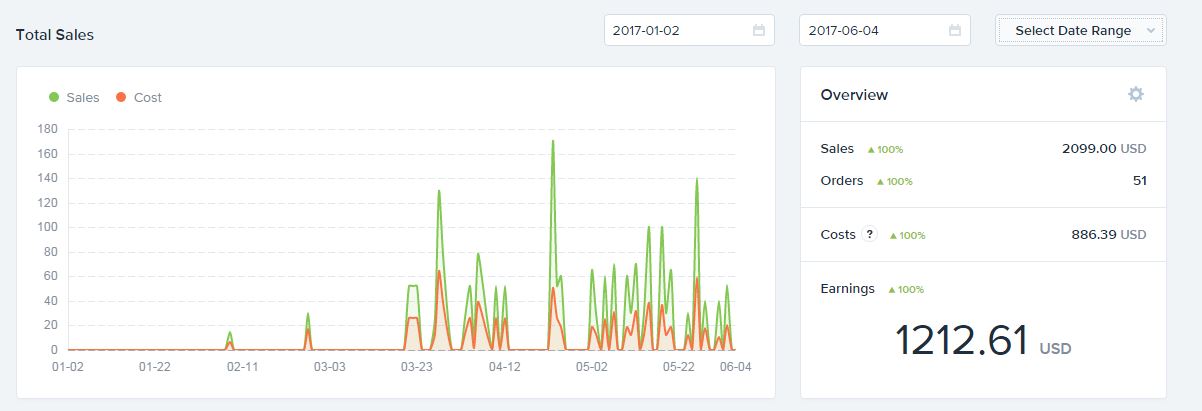
I finally have this afternoon to rest and reflect. I filed all my receipts, mails, and letters. It feels good to unclutter and get everything into my filing system to make things systematic. See below picture for four months of hard work from the team on our ecommerce store (my side business - another source of income). I was not able to contribute much due to my work commitment. I only worked on product fulfillment and customer services. We have not been able to achieve break even stage, the below figure does not include cost on Facebook marketing.

Figure 1 - Revenue from ecommerce store


In Mid May, I have cleared the mortgage and close to debt free. See below figure.


Figure 2 - Clear our mortgage
I could have deployed the money to generate higher returns and complete our quest to achieve financial freedom earlier but it was a family decision. Recently I completed reading a classic book "100 to 1 in the stock market", it is a good book and I learnt a lot from it. This has shaped a new investment approach. I am trying to formulate whether I should take a more "income" approach or "growth" approach. If the company gives out dividend instead of retained earnings, it will be slower to grow. You cannot have the cake and eat it. If the company has a lot of cash, achieves low return on equity and does not give out dividend, the shareholders are worst off. In Singapore context, I will prefer the company to give out the dividend as I do not see very brilliant business owners as compared to Thailand, Asia and USA. At this moment, I have 60% of my portfolio in "income" stocks and maybe I should rebalance to position 70% in growth stocks.

Recently, I saw a few posts on a Facebook group discussing a topic on "30 years old and have 100k". I believe everyone is a winner if they are able to achieve financial freedom at 30, 40, 50, 60 or 70 years old. This is your own journey, it is never a competition. I just need to achieve SGD 2 m in my portfolio and I will call it a day. My mentor wants a SGD 10 m milestone. It depends on your lifestyle and ultimately how much do you need. I just want to have the freedom to choose my own lifestyle.

I tabulate JC Fund account and in May the Fund has achieved SGD 920k (cash position) and the fund should be able to cross the SGD 1,000k mark by end of 2017.  

Friday, 19 May 2017

My Family Quest

Today I had a discussion with my mentor, his mentor has stopped his career with Lim & Tan. He has made enough for himself and the family, he decided to call it a day and spend time traveling with the wife.

My mentor has a total equity net worth of about 2.5m worth. He intends to ask his wife to stop working July 2019. The quest is in progress. My quest has a lower benchmark, I will ask my wife to stop working July 2021 with a total equity/cash net worth of 2m.

I saw the news article which interviewed the blogger foreverfinancialfreedom Halim. He is 32 this year and aims to achieve financial freedom by 35. It is a good direction which Halim is working towards and I wish more singaporeans can learn from him.

Presently my household monthly expenses is close to sgd 8k. If both of us stops working, the income tax will not be applicable, then it should come down to lesser than sgd7k. 

I need a passive income of sgd 85k

This year due to special dividend, I am looking at sgd 60k which is not too far off from my ideal range. Probably another 5 years, I should reach my end goal.

2018 January 900k - 36 years old
2018 December 1100k - 36 years old
2019 December 1300k - 37 years old
2020 December 1500k - 38 years old
2021 December 1700k - 39 years old
2020 December 1900k - 40 years old
2021 December 2000k - 41 years old 


Call it a day and try to travel the world, I will continue to work but at my own call. I want my wife to be a housewife and spend time with the family.

Thursday, 24 December 2015

Supplementary Retirement Scheme (SRS)

I met up with my financial planner who is professional in his advise and planning which is different from those who I met in past. 

Today I am going to discuss about Singapore Supplementary Retirement Scheme (SRS). The SRS is Singapore government's strategy to address the financial needs of a graying population. SRS is voluntary unlike the CPF. The contribution can be used to purchase investment instruments. Contributions to SRS will enjoy tax relief, 50% of the withdrawals from SRS are taxable at retirement. SRS account is deemed closed at the end of the 10th year of withdrawal period. Any returns from investment through balance in SRS account after Deemed Withdrawal has applied will be taxed.

For 2011 to 2015, the yearly maximum SRS contribution is $12,750 and from 2016 onwards, the maximum contribution will be at $15,300. The strategy which I am thinking of adopting will be to accumulate a maximum of S$400,000 at the age of 62. Then I will draw down $40,000 per year. As half of the amount will be taxable and the first $20,000 will be tax free or 0% tax. From the taxation point of view, with the contribution of SRS will help me to save approximately $1,000 on tax. I can use this contribution to invest on a high dividend stock and grow my tool for retirement.

Below is some illustrations of the calculations:


First $80,000 - $3350
Say next $20,000 - 20000 x 11.5% - $2,300
Total tax = $5,650

If you contribute to SRS

First $80,000 - $3350
Next $20,000 less $12,730 = $ 7,270 (If contribute maximum amount to SRS)
This tier will be subjected to tax of $7,270 x 11.5% = $836.05
Hence total tax now = $ 3350 + $836.05 = $4,186.05

I will contribute to SRS if I still have this happy problem next year. This year is a blessed year, I will enjoy tax relief of $5,000 from my newborn. I need to save up on my emergency fund of 6 month expenses. I did a forecast, this will be achieved by June 2016. This forecast amount will allow me to clear my existing short term loan. Furthermore, this is assumed that I do not throw any more fund into the stock market.


Sunday, 29 November 2015

Strategies to Early Retirement

Early retirement to me means retiring at the age of 35, it can be 50 for you. Early retirement planning is the same as conventional retirement. However, you have lesser time to achieve what others usually achieve with 40 years of work. In addition, you will need more money to last throughout your retirement with an extended spending phase of around 50 years (say I want to retire at 35 and I live till 85). Simply put it, it is having less time to accumulate your wealth and more time to enjoy life.
Conventional retirement planning involves saving and passive investment which is a slow and secure way to retirement. You can maximise your Special Account in your CPF, invest your money in a diversified portfolio and reap the rewards through capital gain and dividends. Conventional retirement planning also involves in extreme saving rate of more than 70% and setting aside money to have a comprehensive insurance coverage. 
The downside of passive investment is your dividend income may not grow fast enough for those who are looking for early retirement. Long term returns will be between 2-8% net of inflation which is not a rate to grow wealth for those early retirement. In addition, there will be years of negative growth for a diversified portfolio which is what I am experiencing, for this year 2015, the portfolio is down 10%.
Losing compound growth as a wealth building tool due to shorter time frame will require you to add non-conventional method to your plan. 
1. Extreme Frugality - I have save more than 70% of earned income for 8 years. It is possible but not everyone can agree to this.
2. Leverage - it is a double edged sword tool, it can help you to grow your wealth faster but margin call on property or stocks can cause a downfall.
I am trying to retire at age 35, I saved bulk of my earnings through frugality. Currently, I am learning to increase on my investment skills and carry out active investing. It requires dedication and discipline.
A lot friends in Singapore uses real estate to achieve early retirement, because it has financial and business leverage. Another path is leveraging other people's time through business ownership. When you hire someone, you get to have a total of 16 hours per day. Assume that we work 8 hours a day. In summary, there are three paths to wealth, stocks, real estates and business. I am planning to combine all three paths, coupled with extreme frugality to achieve financial freedom, attain early retirement by 35.
Rule 1 - Build an investment portfolio with dividend income which is sufficiently more than your present and forecast maximum expenses. You can only spend your residual income and never touch the principal asset.
Rule 2 - You need to grow your assets at a rate faster than your annual inflation rate. If not, inflation will eat away your gain and your spending power will be eroded.
Rule 3 - You need to grow multiple source of residual income. You need to have dividend income, rental income and business income.
Rule 4 - You need to have a comprehensive insurance to insure that no external forces can affect you when least unexpected.
I need to make a plan when I retire early, I will not engage in full time leisure because I will get bored of life. I want to retire early because I want to create a lifestyle which is more compelling than my present lifestyle. My parents and parents in law are getting old (in their 60s) and my parents-in-law are staying in Hong Kong. My wife and me need to have freedom to choose where we stay at and not confined to our annual leave. In addition, I need to have a passion and activity which stimulates me, which I will jump out of bed every single morning. My plan is to move into investment business on a full time basis, help people to grow their portfolio and retire early and seek out good property deals and businesses. That is my definition of early retirement, doing something which I am passionate.
Retirement planning is creating a fulfilling and complete life experience. Then live it.


Latest Post

We have moved!

We have moved to a new website: www.jcprojectfreedom.com Visit us there!