Showing posts with label mindset. Show all posts

Sunday, 25 February 2018

Warren Buffett's advice to survive a market downturn

For the last 53 years, the company has built value by reinvesting its earnings and letting compound interest work its magic,"Buffett wrote. "Year by year, we have moved forward. Yet Berkshire shares have suffered four truly major dips. Here are the gory details."

March 1973 to January 1975 - 59.1% decrease
10/2/87 to 10/27/87 - 37.1% decrease
6/19/98 to 3/10/2000 - 48.9% decrease
9/19/08 to 3/5/09 - 50.7% decrease

All four of those big drops coincided with major market moving events.

59.1% plunge from March 1973 - January 1975 occurred when the US economy was mired in an ugly recession resulting from the oil crisis and fallout from the Bretton Woods agreement. The benchmark S&P 500 lost as much as 44% during that time.

The 37.1% drop during October 1987 happened after Black Market stock market crash. The S&P 500 bottomed out at a loss of 34%.

The 48.9% slide from June 1998 to March 2000 occurred just ahead of the dotcom bubble's burst. The S&P 500 actually gained 27% during this period.

The 50.7% plunge from September 2008 - March 2009 occurred during the darkest days of the Great Financial Crisis. The benchmark S&P fell 44% over this time.

"This table offers the strongest argument I can muster against ever using borrowed money to own stocks,"Buffett wrote.

There is simply no telling how far stocks can fall in a short period. Even if your borrowings are small and your positions aren't immediately threatened by the plunging market, your mind may well become rattled by scary headlines and breathless commentary. And an unsettled mind will not make good decisions."

Buffett concluded that big drops are great opportunities for those who are not in debt.

To reflect on his words on the February minor correction, I was straddled with a huge debt in AAPL options position which cause me to lose focus on the bigger picture. It was a good opportunity to buy into undervalue companies then. Never be in an over leveraged position.

If you can keep your head when all about you  
    Are losing theirs and blaming it on you,  
If you can trust yourself when all men doubt you,
    But make allowance for their doubting too;  
If you can wait and not be tired by waiting,
    Or being lied about, don’t deal in lies,
Or being hated, don’t give way to hating,
    And yet don’t look too good, nor talk too wise:

If you can dream—and not make dreams your master;  
    If you can think—and not make thoughts your aim;  
If you can meet with Triumph and Disaster
    And treat those two impostors just the same;  
If you can bear to hear the truth you’ve spoken
    Twisted by knaves to make a trap for fools,
Or watch the things you gave your life to, broken,
    And stoop and build ’em up with worn-out tools:

If you can make one heap of all your winnings
    And risk it on one turn of pitch-and-toss,
And lose, and start again at your beginnings
    And never breathe a word about your loss;
If you can force your heart and nerve and sinew
    To serve your turn long after they are gone,  
And so hold on when there is nothing in you
    Except the Will which says to them: ‘Hold on!’

If you can talk with crowds and keep your virtue,  
    Or walk with Kings—nor lose the common touch,
If neither foes nor loving friends can hurt you,
    If all men count with you, but none too much;
If you can fill the unforgiving minute
    With sixty seconds’ worth of distance run,  
Yours is the Earth and everything that’s in it,  
    And—which is more—you’ll be a Man, my son!


Source: A Choice of Kipling's Verse (1943)

Friday, 16 February 2018

JC Fund and JC Options Fund - personal review

The Singapore and Hong Kong markets closed today at 12pm and I was looking at the results of Thaibev. I knew the acquisitions will make the results look nasty but did not expect to be this bad. I sat there thinking about the next 1-2 years outlook for Thaibev. I am worried of its over leveraged position and rising interest rate environment. In the short run, the stock will not perform well but the business is consolidating to grow from strength to strength.

I was wondering why I chase after bad investment such as HPH Trust USD, double down on my losses and did not cut this counter last year. In fact, there was a window of opportunity when it was even profitable.

I was thinking of this recent market correction when there were opportunities for me to switch out laggard IBM shares to acquire AAPL shares. I done my homework and I was convinced that AAPL was mispriced. Why I did not do it? There are a few other companies which provide that window of opportunity to switch and move my money into a faster lane. I seem to prefer status quo (maybe I have a fear of losing money) or I have no confidence of my own valuation?

My portfolio consists of mainly dividend stocks and only 1 growth stock. I am playing a defensive role here. Maybe I believe that now I am jobless and there's no income coming in from my side, I need income from dividend. I just want to be prudent and to be paid while waiting. I think everyone has different investing approach and as long as the same objective is been achieved, it does not matter which route you take. I am just thinking whether I should move away from net-net stocks which sometimes can be value traps.

As of 14th February post market share price of AAPL was USD 168.93, maybe on the 16th February, my AAPL sell put options will expire with share price above USD 170 (20th February when I review this, the option expires worthless and share price closed at USD 172 on 16th February 2018). On hindsight, I could be profitable instead of pocketing the huge losses. However I should remember the important lesson learnt. What if a huge bear wakes up and share price drops by 50%? Will I have money to top up margin maintenance call? Nope. It will be a worse scenario resulting into a very unhappy Chinese New Year.  Thou never gamble with leverage and trade within your cash and cash equivalent. Always follow the checklist. If it is a huge gain, there is bound to be another larger loss later on (this applies to me, I suffered twice on this - a total loss of USD 32k on two trades). If I follow a small gain of 1% per month, this will be a safer approach in the long run.

Overall, as of 15th February, JC Fund and Option Fund portfolios have recovered to a neutral position with no paper gain or losses. Let's think of a strategy on how to shift the stocks around and what sort of mistakes to avoid in the future.
  • Rebuild watch list - understand beta of each stocks, moat, intrinsic value and margin of safety
  • Re-balance portfolio towards end of Q1 and review again in Q3.
  •  Withdraw some profit every quarter to spend on the family

Sunday, 29 October 2017

Opportunity Cost of an Employee

My mentor who is one of the top remisier boast to me that his net worth will be increased by SGD 1 million this year. His method is pure value investing only. Sometimes, he will use CFD to short a few counters. His CFD trades are for "kopi" money or just for fun. Maybe by next year, he will cross the SGD 4 million mark. He is 36 years old only.

I need to compare again, he can spend bulk of his time to research on undervalued stocks. He has a war chest of investing ideas and portfolio of stocks from the best companies spanning from Europe, Japan, Hong Kong, USA and Singapore. 

He is setting out to start his own hedge fund and wish me all the best in my investing journey. As I am not an Accredited Investor in 2017 but I believe I will meet the requirement by 2018. Nevertheless, I will choose not to invest in his hedge fund because I believe in DIY. Nobody is more concerned of your finances than you. If I invest my own money and I lose it, it is solely my responsibility. I won't want to leave my money in an active managed fund without having the control and not knowing what is the money been used for. 

I was on a plane when I draft this. I started reading financial reports after my boss return to his seat. I realize reading financial report is a very time consuming activity in order to understand the transaction history, growth story, and background of the business. It will probably take 1 full day to digest one single company's financial reports and conduct the company's SWOT analysis. In fact, there are a lot tools which I learn from my MBA that can be applied on stock analysis. 


I felt that there are a lot of investment opportunities are lost because of working as an employee. Every working day, I spend 3 hours commuting to and fro (I will read on MRT or take a nap), another 8 hours in meetings, toilets, lunch and some work, another 2-3 hours at night trying to wrap up my tasks for the day. Probably left with another 1-1.5 hrs at midnight to read a book or a financial report. Due to the lack of time, when I chance upon a good company and the stock price had just doubled in the last 3 months, I will feel upset.  
  
If my option income can achieve at SGD 10k per month, I will become a full time investor cum options trader. My testing model will be SGD 10k per month for 3 months consecutively and sustainability test after a major share price correction. It is no good if all the profits are wiped out after a crisis and back to square one.
  • 3 consecutive months of SGD 10k options income
  • Survive and sustain 1 crisis
 

Thursday, 31 August 2017

Encounter with my childhood friend

One of good friend whom I grow up with approached me recently and asked me whether I will like to invest in CPU for bitcoin mining. He explained to me that you just need to invest about usd6k and you can get minimum usd 600 per month which is about 10-20% return per month. 

I look up online and realize you can buy all these computers from Amazon. However they consume a lot of electricity and produces a lot of heat which requires secondary cooling. It will be profitable if you stay in college or if you live in a country where electricity is free. It doesn't make sense for me to do this on a small scale basis in Singapore. 

So I explain to him that I will rather stay within my circle of competence. If he wants to do it, he can go ahead and the value of bitcoin may increase to 20k in the future. Who knows? This can be very profitable. However I just want to be in stocks and options and moving on to money management business. I told him I have limited resources and time and just want to focus on what I can make money. 

He told me" your knowledge of what's possible is limited by your knowledge of what's possible".


Ok. You win. I am contented.

Friday, 21 July 2017

Power Assets 2017 Half Year Results

Power Assets Group's unaudited profits for the six months ended 30th June 2017 amounted to HKD 4,024 million which is 16% higher compared to 2016 HK 3,476 million.
The company has announced an interim dividend of HKD 0.77 per share which is higher by 10% than compared to 2016 HKD 0.7 per share. In addition, there is a one-off special interim dividend of HKD 7.50 per share in order to address shareholders' expectations while balancing Group's financial capacity for future acquisitions.  

Let us pause for a while and address this great news for JC Fund.


Total Dividend Income = 30,000 shares x HKD (7.50 + 0.77)/share = HKD 248,100/=
which is equivalent to approximately SGD 43,000. 

This will be paid by 29th August 2017.

I know this special dividend will serve a higher purpose by boosting 6.2 billion for CKI to acquire another company. 

In the report, it was said that DUET was well aligned with the Group's strategy with energy generation, transmission as well as distribution. It is said that DUET will build, own and operate new unregulated gas pipelines. I need to investigate this further and forecast how this will affect the growth of the business.

Enough for the good news, now bring up the bad news, I may experience 2nd retrenchment in 2017. I cannot reveal too much but the company may not require my service anymore. It is time to move on. This is a major disruption to our quest. I need to believe in God's plan for me and I must believe that he knows what I want in life. He will open up the path for me to bring me back to my desired path. I felt disappointed when I hear the news that we did not win the project but I know we have done our best.

Time to gather myself and plan ahead.

Friday, 7 July 2017

Key Learning from Millennial Money

I find this an undervalue book and thank God it pops up in front of me in the bookstore.

Once you have set the investing strategy, stay with it. Don't switch to a new one just because the original one has not work for the last year or two.

Value over Growth: Low EV to FCF, low Price to Cash Flow, Low Price to Earnings, Low Price to Sales, low EV to EBITDA

Quality over Junk: High ROIC, high ROA, high ROE, high Interest coverage

Follow the Trend: High six month momentum, high nine month momentum, low volatility

Follow the Leaders: High stakeholder yield, high shareholder yield, high dividend yield, high buybacks

In the book, it teaches you the right mindset which is to have a long term investing strategy. Do not let emotions dictate you during the both market extremes of Greed and Fear. Stay invested in all circumstances. I have managed to invest during the Greece crisis and Chinese stock crisis but I failed to continue my average down of OCBC. I was buying OCBC in large amount during 2015 (if I recall correctly) from $9 to around $10.4+. When the trend turn, I did not exit but continue to buy more at $8+. However, I did not buy more when it dropped to $7+. I switched out when the price recovered to $9+ and in 2017 July is $10+. Sometimes, it is better not to do anything. During the oil crisis, I was too terrified by Swiber and Ezra, I failed to buy McDermott when it dropped to $4. All these are real fear, you do not know when is the lowest and you are afraid to throw good money at the bad ones.  

Apart from rules based investment strategy, you need to evaluate the business model and whether the business has Moats. I was discussing Foot Locker with my mentor and he felt that this company does not have economic moat and it is like a distributor business model. He will rather buy Hour Glass, at least the assets are ROLEX and other branded watches. Hence, I will recommend to use Moats, SWOT analysis and understand business positioning other than looking at the financial numbers.

Investing is fun and it requires a holistic approach to acquire strong businesses for your better future! 

Monday, 3 July 2017

Differences between Investment and Gambling

There is a minority group of people who are afraid of taking airplanes because they are terrified by news of plane crush such as MH370. In fact, the odds of a plane crash are one for every 1.2 million flights, with odds of dying one in 11 million. Your chances of dying in a car or traffic accident are one in 5,000.

Similarly, there is a group of people who will leave their money in the bank as their theory is "the stock market is a gamble and buying shares is equivalent to gambling. They perceive that if stock price goes up, they will win the game and if stock price drops, they lose. My mother always remind me that," Ah boy, you should stop gambling in shares, it is not so easy." She will also ask me to help her buy those penny stock at a few cents, the lower the price the better she perceives them as cheap. I always need to advocate it is the value not the price.

Let's discuss the difference from the end results point of view between gambling and investing.

1. The Chinese saying "you lose nine times in ten when you gamble"

The nature of gambling is "you lose, I win" or "I win, you lose" or it is a zero sum game.

2. Investing is a fair game

The international market in stocks is fair and all parties can win if everyone buys into the shares of a strong and growing company. Then who are the losers? Apart from market crash (if you did not sell out, you won't lose, market rebound back most of the cases), most of the countries' stock markets have an upward trend in the long run. If an investor buys the stock for $20 and gets a yearly dividend of $2, he will recover his capital in 10 years time.

The 3 exceptional cases of market crash are:

a. 1991, Japan market drops from 36800. In 2015, it was at 20,000 which is 54% of original high
b. In 1991, Taiwan market drops from 12682, in 2015, it was 9,000
c. In 2007, China market index was 6,200. In 2015, it was 3,600. 

Let's look at the difference in terms of the process

1. Gambling is a game of probability

Most of the games in a casino is based on chances except for cards counting for game of Blackjacks. If you are an expert and casinos may soon have you on their unwanted guests list and ban you from entering their complexes.

2. Investing is a skill set

The professional investors can use their skills in stock market. They can make money using fundamental analysis and technical analysis.

Thursday, 29 June 2017

Differences between Mr Poor and Mr Rich

1. Learn how to invest
From the above table, the rich are wealthy because the crux lies in willingness to invest time in reading and learning.

2. Time spent on learning
The rich and free spent almost twice the time on learning than the poor.

Wednesday, 28 June 2017

Create your own retirement plan

1. The peril of longer life expectancy
Are you ready? Most of the elderly aged 65 years old and above do not have sufficient retirement sum and they depends on their children and the government to assist. The age group between 45 - 64 years old needs to depend on oneself and may need to extend their retirement age. Hence, a lot of people who are not ready will find themselves working beyond 65 years old.

As one ages and lose the ability to provide, there are other insecurities such as fear of deterioration in health, run out of money and need to take care of spouse.

2. How to get yourself prepared?
A lot of people like to comment on how some entrepreneurs are very thrifty and they become wealthy out of their thriftiness. Actually, their wealth comes from their leverage through business and not through saving on small money such as your favorite daily Starbucks coffee. Thriftiness is good but it can only create small amount of money. In order to create wealth, you need to invest in shares.

In 3rd century BC, Greek philosopher Archimedes discovered the principle of mechanical advantage in the lever. His famous remark with regards to the lever,"Give me a place to stand on, and I will move the Earth." In the world of investment, the pivot is "investment knowledge", with this knowledge, you can choose the right investment tools such as ETFs, bonds, shares, forex, futures, etc. You can gain leverage through investment knowledge.

From our previous post, assume our example character is a 30 years old single man, his annual salary is between SGD 36k to 48k and he is able to save SGD 12k per annum. Assume he works from 24 years old to 30 years old, see below for illustration. 


By 30 years old, he should be able to achieve a total saving amount of about SGD 100k. Based on SGD 36k annual income, SGD 12k is a saving rate of 33.3%. If the single man stays with the parents, a saving rate of 33% is highly feasible.

The above illustration is based on a very conservative investment of 4% return.

3. The rich makes more money with money and sometimes with other people's money
After 31 years old, with SGD 100k can be used to pay for property down payment or invest in more shares.

The rich makes more money with money. In 2013, Capgemini and Royal Canadian Bank published a report on 2013 Global Wealth Report and those with asset of USD 1m and above will have access to different financial tools and investment products. They are able to accumulate more wealth than the lower income group.

4. At the start, it is very slow but after 40 km/hr, it will be faster
Remember the momentum theory we learn during our college days, the vehicle/car when it first overcome its inertia, it is moving very slowly and once it hits 40 km/hr, it starts to pick up and can accelerate. The SGD 100k we seen earlier will roll and compound and grow over the years. When the man reaches 60 years old, he will achieve SGD 980,426 and by 61 years old, he will achieve SGD 1,031,644. Imagine if he can change his return from 4% to 10% or increase his saving rate or increase his income.

If he can achieve 10% return, he can achieve SGD 1m by age 47 years old.

If he can achieve 10% return and double his savings, he can achieve SGD 1m by 40 years old.

It is highly doable. All it takes is a bit of discipline and willingness to invest for your future. 


Tuesday, 27 June 2017

Money not enough? That's why you need to invest

In Singapore, the property price is expensive and based on the average salary, it will take a lifetime to pay off the house. Currently, it is still a person's working life time, if it increases to 2 generation to pay off the house, it will become very scary.

1. Life time income of SGD 1,946,880

The below table is from Ministry of Manpower, the average salary in 2016 is SGD 4,056/month. Based on 40 years of working life, the total income is SGD 1,946,880. 


2. Life time expenses of SGD 2,704,000

a. Expenses during single-hood
In Singapore, the average man age is 30 years old and woman is 27 years old. Assume that the man graduate when he is 24 years old, he will take 6 years before he get married. Assume that he has an average monthly expense of SGD 2,000. His total expense for 6 years will be SGD 144,000.

b. Expenses from 31-60 years old

Assume that the house is SGD 1m including incurred interest over a lifetime will be SGD 1.25m.

Assume that he bought a car for SGD 150,000 including COE

Assume that he has a kid, the cost of bringing up will be SGD 200,000 (conservatively speaking).

Assume that monthly expense from 31-60 years will still be SGD 2,000. 30 years will be SGD 720,000. I did not take into consideration pay increment and increase in expenses for the illustration.

Hence, total expenses between this age group will be SGD 2,320,000.

c. Expenses between 61-80 years old

Assume that for retirement the man just need to go downstairs to drink kopi o and eat mixed vegetable rice, his monthly expense is only SGD 1,000 including occasional visit to polyclinic for medical expenses.

His expense will be SGD 240,000.

Therefore, this friend of ours will face a shortage of SGD 757,120.

Yes, he can buy a HDB and if he is married, both can help to pay down the house. However, I do not foresee any surplus for a better and earlier retirement.


From the above picture, it shows a conversation between myself and a friend. He was burnt previously before because he invested in get-rich-quick scheme through gold investment. However, he should learn from the mistake and educate himself in terms of investing. He has another good 25 years of working life and with proper planning, he can achieve a fruitful retirement. "Not much money" is not true because he saves a big portion of his income and if there is not much money then it will become a real headache. When he says that he has no interest, he is rejecting me not at the notion of investing. Will anyone be not interested in money? If I tell you that you can make a lot money, will you be interested? Yes, I will definitely be. That's why I am on this quest to understand how to crush this shortage between income and expenses and retire earlier. I will choose to work on my own terms because I am financially free not because I have to. 

In my next post, I will share about how you can gather small wealth through savings and middle class wealthy through shares investment.

Sunday, 18 June 2017

VIC Boot Camp 16th - 18th June 2017

I reached Singapore on Thursday 15th June at 10 pm and finally got home around 11pm. By the time I managed to unpack and sleep, it is close to 1 am. The next day I woke up early at 7 am to attend the first day of the boot camp. I joined the VIC boot camp with an initial mindset that I am already a seasoned investor and I just wanted to learn about options. I wanted to learn how to use options to maximise my gains.

I realised that this course is unique and has its strengths. If you want to learn all the fanciful options strategy like vertical, diagonal, etc you will be disappointed. However, this course gives you a very well defined strategy to value a business, access its strength and weakness, conduct valuation and apply sell put or sell call options to further protect your position. It is difficult to lose money using this approach. The course will touch on portfolio management which I never realise is an important investment strategy. I have read everything from "The Five Rules for Successful Stock Investing" by Pat Dorsey and various books on portfolio management but somehow I never piece everything together. This course helps me to align my knowledge, coupled from what I learn in the last 3 days to be a better investor.

I believe there is alot I need to learn and I will continue on this lifelong learning journey to be a better investor. I enjoy learning while progressing towards our quest of financial freedom.

The next few things to do:
1) Fund my Thinkorswim account with real money, start small and test it out
2) Stock screen SG stocks
3) Stock screen HK stocks
4) Stock screen US stocks

Then I will get together with some of my like minded friends and brainstorm on what businesses to acquire. 

Never stop learning...    

20th June 2017
I transferred USD 4,390 to my Thinkorswim account. Let's start slowly and sell put on 1 contract first. 

The money should be in the account either Wednesday or Thursday. Look forward to it!

The new quest is to make USD 120/month in premium to cover my monthly installment for VIC course. Once I can do this consistently for 6 months, then I will attend Ken Teng's OMP course. 

13th August 2017
I got greedy in 2nd month and made a lot of mistakes which contravene to the system which I was been taught. I signed up for Ken Teng's OMP course in November. 

Sunday, 4 June 2017

04/06/2017 Recent update

Since the day I joined the new company to assist with the bid, I had been working till midnight almost every single day and even on weekend. Last night was the submission date for the first bid, we worked till midnight in the office and successfully submitted it online.

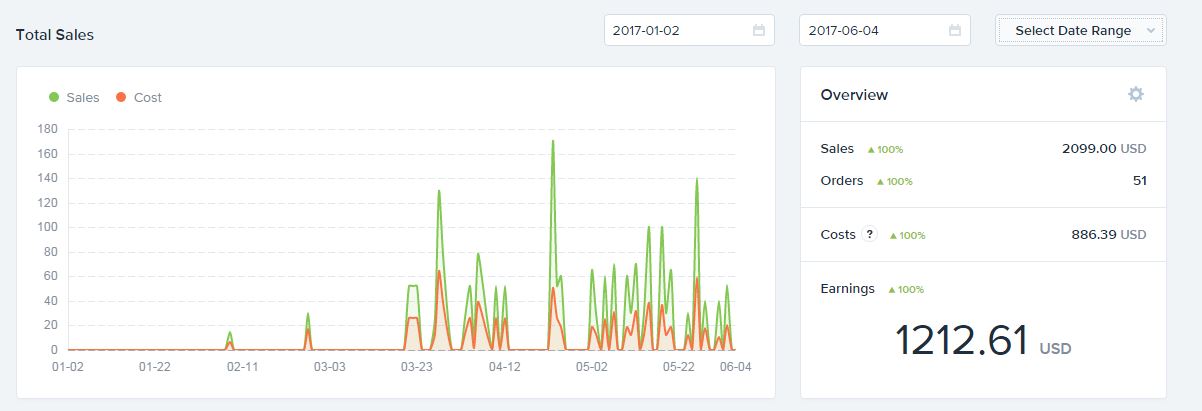
I finally have this afternoon to rest and reflect. I filed all my receipts, mails, and letters. It feels good to unclutter and get everything into my filing system to make things systematic. See below picture for four months of hard work from the team on our ecommerce store (my side business - another source of income). I was not able to contribute much due to my work commitment. I only worked on product fulfillment and customer services. We have not been able to achieve break even stage, the below figure does not include cost on Facebook marketing.

Figure 1 - Revenue from ecommerce store


In Mid May, I have cleared the mortgage and close to debt free. See below figure.


Figure 2 - Clear our mortgage
I could have deployed the money to generate higher returns and complete our quest to achieve financial freedom earlier but it was a family decision. Recently I completed reading a classic book "100 to 1 in the stock market", it is a good book and I learnt a lot from it. This has shaped a new investment approach. I am trying to formulate whether I should take a more "income" approach or "growth" approach. If the company gives out dividend instead of retained earnings, it will be slower to grow. You cannot have the cake and eat it. If the company has a lot of cash, achieves low return on equity and does not give out dividend, the shareholders are worst off. In Singapore context, I will prefer the company to give out the dividend as I do not see very brilliant business owners as compared to Thailand, Asia and USA. At this moment, I have 60% of my portfolio in "income" stocks and maybe I should rebalance to position 70% in growth stocks.

Recently, I saw a few posts on a Facebook group discussing a topic on "30 years old and have 100k". I believe everyone is a winner if they are able to achieve financial freedom at 30, 40, 50, 60 or 70 years old. This is your own journey, it is never a competition. I just need to achieve SGD 2 m in my portfolio and I will call it a day. My mentor wants a SGD 10 m milestone. It depends on your lifestyle and ultimately how much do you need. I just want to have the freedom to choose my own lifestyle.

I tabulate JC Fund account and in May the Fund has achieved SGD 920k (cash position) and the fund should be able to cross the SGD 1,000k mark by end of 2017.  

Friday, 19 May 2017

My Family Quest

Today I had a discussion with my mentor, his mentor has stopped his career with Lim & Tan. He has made enough for himself and the family, he decided to call it a day and spend time traveling with the wife.

My mentor has a total equity net worth of about 2.5m worth. He intends to ask his wife to stop working July 2019. The quest is in progress. My quest has a lower benchmark, I will ask my wife to stop working July 2021 with a total equity/cash net worth of 2m.

I saw the news article which interviewed the blogger foreverfinancialfreedom Halim. He is 32 this year and aims to achieve financial freedom by 35. It is a good direction which Halim is working towards and I wish more singaporeans can learn from him.

Presently my household monthly expenses is close to sgd 8k. If both of us stops working, the income tax will not be applicable, then it should come down to lesser than sgd7k. 

I need a passive income of sgd 85k

This year due to special dividend, I am looking at sgd 60k which is not too far off from my ideal range. Probably another 5 years, I should reach my end goal.

2018 January 900k - 36 years old
2018 December 1100k - 36 years old
2019 December 1300k - 37 years old
2020 December 1500k - 38 years old
2021 December 1700k - 39 years old
2020 December 1900k - 40 years old
2021 December 2000k - 41 years old 


Call it a day and try to travel the world, I will continue to work but at my own call. I want my wife to be a housewife and spend time with the family.

Sunday, 9 April 2017

General Updates over the Week

I attempted the M5 exams on 7th April and I failed.

My ex-boss is offering me a contract role to assist with him for 2-3 months. If he is able to secure the project, it may evolve into something long term. The pay is almost equivalent to what I was previously drawing. Hence, I need to proceed with it and delay getting on board my remisier role. More funds mean more ammunition for me to last this battle.

On 8th April, I went to attend Alvin Phang's Azonbible course. There are a lot of things to learn and need to do. I met a lot of interesting people during the course itself. I met full time ecommerce business owners who are doing EBay, Amazon dropshipping, Aliexpress dropshipping, etc. Amazon is changing its game and encouraging its sellers not to buy reviews or provide free samples in exchange for reviews. Amazon is encouraging sellers to advertise to improve on ranking. 

Since early January, I have been working together with three other friends on Shopify ecommerce business. We are getting slight improvement in our sales but yet able to scale it up in a way. There is only one guy who is doing the hard work on Facebook marketing and video editing which is too hectic and affecting his affiliate marketing business. Below is a snapshot of our progress. It is nothing compared to very successful ecommerce stores. However, we will start small and continue to buy data to test. Reiteration until we are successful one day.


There are other cost such as Shopify monthly subscription fees and advertising cost on Facebook Business platform. We are only at break even stage. The above picture only shows the profit margin of the products that we are selling.

The concept to success in Affiliate Marketing and Ecommerce are the same, you just need to launch fast, if it fails kill it and relaunch again until you find the winning combination, then you scale it up. It is like a data scientist who is doing an experiment with lots of different variables. He needs to keep one variable and all other constant to conduct the test. Then he records his findings. A lot people come into the business thinking that they can make some quick bucks fast and left disappointed. I was one of them but I am slowly changing my mindset. I am seeing this as a business which you need to build up over the years.

There seem to be alot of things which I am trying to achieve all at the same time. With the scatter effort, I may not amount to anything at all. I need to think whether FOCUS is the best strategy. 

Friday, 31 March 2017

Investment Commitments

I am reading my M5 textbook and I finally come across something which is useful. Ops.

The Know Your Client states that in order for a financial advisor to make a recommendation, he needs to understand the client's investment objectives, financial situation and particular needs. From there, the financial advisor needs to carefully curtail a plan for the client.

This brings me to Investment Commitment. Are you able to commit money to invest on a regular basis? If yes, then you can harness the advantage of dollar cost averaging. I had an unfair advantage because since 2009 onwards, I was the Constant Cashflow Investor. I have strong net income (in my context) which comes in on a monthly basis and I will use them to acquire financial assets. I have a high saving ratio as I live frugally. I am quite proud of how I allocate resources most of the time. Hence, it is possible for me to get out of a "bad" investment (temporary having paper loss), I can choose to continue to buy more and average down the cost. Using this approach, I have seldom lose money and able to either i) grow the portfolio by acquiring more or ii) take dividend while waiting for stock to rise back up and reinvest to compound it further.

I will soon become the second type of investor because there is no income from employment. This is the Lumpsum Investor. They do not have constant income and they rely on an one-time investment, park it there and forget about it. Then how should this type of investor plan the investment game? There are a lot of experts who will recommend going in based on stages. For instance, pump 20% first, if it drops another 10%, pump into another 20%, so on and so forth. However, will it be a concentrated move or diversified investment? This is a tough call. I will think that if you do not have a strong stock broker to work with or you do not good investment skills, just buy ETF. Stagger the lumpsum into the ETF and reinvest the dividend. You should be able to get above average returns. Does this mean I will go into ETF? Yes, if I cannot get above average returns. Alternatively, I will use ETF to invest in countries such as Russia and China. 

Now I am going back to my studies, continue reading page 63 of 519. What a way to spend my Friday evening.

Thursday, 23 March 2017

Retrenched!

22/3/2017
At 4.30pm today, my managing director called me into the room and explained to me that due to the current activity levels in the Asia Pacific market, the company had no choice but to close the Singapore office.

We discussed slightly on the compensation issue. 

I finally received the letter of retrenchment. I was made redundant according to the letter. I had written in my Evernote in 2015 "I will make myself redundant when I turn 35." I prayed about it. I did not know God will answer my prayer in his way. It is pretty spot on. My effective date will be 1st April and I need to serve a month's notice. I will turn 35. 

28/3/2017
Today I passed my M1A. It was a close shave because I only prepared based on the CMFAS exam papers.


Two more papers M5 and M6A. 

For the rest of the evening, I spent some quality time with my sister and my nephews. I used to have more time with the elder nephew when I was not yet married with a kid. During the car ride with my sister, she told me she wanted to pay down her house in order to buy another condo. The rationale is to buy a place near to a school which she wants her sons to attend. To me, that is silly but important in the eyes of Singaporean parents. She is committing to two properties which will cost her say $2m. For instance, she moves to the new place and rent out her existing place, the yield will be 2-3% (based on my previous post on the yield of a condominium) and she continues to slave for her 2nd place. Both of my sis and brother in law are specialised professionals in the healthcare sector which provide them with high and stable income. If they only know how to a bit smarter with their money, they will easily surpass me in terms of net worth within a few years. Been a bit smarter, I mean putting money to work harder for them instead of putting them in fixed deposit and intend to pay down the house.

I know they will be rich as her husband's skill set is highly sought after and he operates on one of the most critical organs.

Due to all the exams and administrative stuff, I did not get to follow up much with Singapore market and just eyeing on two of my Hong Kong shares. I sold my 5 lots of one of the stock to lock in some profit. Another 28 lots to go. Take it slowly. The trend is intact and hopefully, a breakout will be seen in days to come. My US portfolio was not affected at all even with all the Trump drama. That is the beauty of having a portfolio which you can sleep soundly at night. 

I bought USD 201 worth of books from Amazon. I need to devour more books than before. Another USD 200 worth of books which I saved for a later purchase date. I have reserved USD 400 for my reading and learning budget. 


Saturday, 4 March 2017

92 Quotes from The Most Important Thing by Howard Marks

Courtesy from 
http://www.arborinvestmentplanner.com/quotes-the-most-important-thing-howard-marks/

92 Quotes From The Most Important Thing

“Successful investing requires thoughtful attention to many separate aspects, all at the same time. Omit any one and the result is likely to be less than satisfactory. (ix)
To me, risk is the most interesting, challenging and essential aspect of investing. (x)
No rule always works, the environment isn’t controllable, and circumstances rarely repeat exactly. Psychology plays a major role in markets, and because it’s highly variable, cause-and-effect relationships aren’t reliable. (1)
First-level thinkers look for simple formulas and easy answers. Second-level thinkers know that success in investing is the antithesis of simple. (4)
You can’t do the same things others do and expect to outperform. (5)
Most people are driven by greed, fear, envy, and other emotions that render objectivity impossible and open the door for significant mistakes. (12)
Inefficient markets do not necessarily give the participants generous returns. Rather, in my view that they provide the raw materials — mispricings — that can allow some people to win and others to lose on the basis of differential skill. (13)
Let others believe markets can never be beat. Abstention on the part of those who won’t venture in creates opportunities for those who will. (14)
The choice isn’t really between value and growth, but between value today and value tomorrow. Growth investing represents a bet on company performance that may or may not materialize in the future, while value investing is based primarily on analysis of a company’s current wealth. (19-20)
Investors with no knowledge of (or concern for) profits, dividends, valuation, or the conduct of business simply cannot possess the resolve needed to do the right thing at the right time. (22)
Establishing a healthy relationship between fundamentals — value — and price is at the core of successful investing. (24)
Bottom Line: there’s no such thing as a good or bad idea regardless of price! (25)
Investor psychology can cause a security to be priced just about anywhere in the short run, regardless of its fundamentals. (27)
Investing is a popularity contest, and the most dangerous thing is to buy something at the peak of its popularity.  (27)
The safest and most potentially profitable thing is to buy something when no one likes it.  (27)
All bubbles start with some nugget of truth.  (28)
Unfortunately, the greater fool theory only works until it doesn’t. Valuation eventually comes into play, and those who are holding the bag when it does have to face the music. (28)
Risk means more things can happen than will happen. (31)
The possibility of permanent loss is the risk I worry about. (36)
Skillful investors can get a sense for the risk present in a given situation. They make that judgement based on (a) the stability and dependability of value and (b) the relationship between price and value.   (39)
Return alone—and especially return over short periods of time—says very little about the quality of investment decisions. (44)
Recognizing risk often starts with understanding when investors are paying it too little heed.  (46)
The value investor thinks of high risk and low prospective returns as nothing but two sides of the same coin, both stemming primarily from high prices. (47)
Awareness of the relationship between price and value—whether for a single security or an entire market — is an essential component of dealing successfully with risk. (47)
So a prime element in risk creation is a belief that risk is low, perhaps even gone altogether. That belief drives up prices and leads to the embrace of risky actions despite the lowness of prospective returns. (48)
The degree of risk present in a market derives from the behavior of the participants, not from securities, strategies, and institutions. (49)
The risk-is-gone myth is one of the most dangerous sources of risk, and a major contributor  to any bubble. (49)
When worry is in short supply, risky borrowers and questionable schemes will have easy access to capital, and the financial system will become precarious.  (50)
Too much money will chase the risky and the new, driving up asset prices and driving down prospective returns and safety. (50)
Investment risk comes primarily from too-high prices, and too-high prices often come from excessive optimism and inadequate skepticism and risk aversion. (50)
When everyone believes something is risky, their unwillingness to buy usually reduces the price to the point where it’s not risky. (55)
When everyone believes something embodies no risk, they usually bid it up to the point where it’s enormously risky. (56)
High quality assets can be risky, and low quality assets can be safe. It’s just a matter of the price paid for them. (56)
Risk control is the best route to loss avoidance. Risk avoidance, on the other hand, is likely to lead to return avoidance as well. (65)
The road to long-term investment success runs through risk control more than through aggressiveness. (66)
Most investors’ results will be determined more by how many losers they have, and how bad they are, than by the greatness of their winners. (66)
Skillful risk control is the mark of the superior investor. (660
You can’t predict. You can Prepare. (67)
Most things prove to be cyclical. (67)
Cycles will never stop occurring. If there were such a thing as a completely efficient market, and if people really made decisions in a calculating and unemotional manner, perhaps cycles (or at least their extremes) would be banished. But that’ll never be the case. (71)
When investors in general are too risk-tolerant, security prices can embody more risk than they do return. When investors are too risk-adverse, prices can offer more return than risk. (75)
The biggest investing errors come not from factors that are informational or analytical, but from those that are psychological. (80)
There’s only one way to describe most investors: trend followers. Superior investors are the exact opposite. (91)
The proper response lies in contrarian behavior: buy when they hate ‘em, and sell when they love ‘em.  (93)
Investment success requires sticking with position made uncomfortable by their variance with popular opinion. (94)
The ultimately most profitable investment actions are by definition contrarian: you’re buying when everyone else is selling (and the price is thus low) or you’re selling when everyone else is buying (and price is high).  (95)
The thing I find most interesting about investing is how paradoxical it is: how often the things that seem most obvious—on which everyone agrees—turn out not to be true. (95)
What’s clear to the broad consensus of investors is almost always wrong. (95)
The very coalescing of popular opinion behind an investment tends to eliminate its profit potential. (95)
If everyone likes it, there’s significant risk that prices will fall if the crowd changes its collective mind and moves for the exit. (96)
Large amounts of money aren’t made by buying what everybody likes. They’re made by buying what everybody underestimates. (96)
In dealing with the future, we must think about two things: (a) what might happen and (b) the probability that it will happen. (97)
Following the beliefs of the herd will give you average performance in the long run and can get you killed at the extremes. (97)
The error is clear. The herd applies optimism at the top and pessimism at the bottom. (98)
It’s not what you buy; it’s what you pay for it. (102)
A high quality asset can constitute a good or bad buy, and a low quality asset can constitute a good or bad buy. (102)
The necessary condition for the existence of bargains is that perception has to be considerably worse that reality. (105)
It’s essential for investment success that we recognize the condition of the market and decide on our actions accordingly. (108)
One way to be selective is by making every effort to ascertain whether we’re in a low return environment or a high-return environment. (110)
When prices are high, it’s inescapable that prospective returns are low (and risks are high).  (111)
You want to take risk when others are fleeing from it, not when they’re competing with you to do so. (113)
High-return environments offer opportunities for generous returns through purchases at low prices, and typically these can be earned with low risk. (113)
Patient opportunism, buttressed by a contrarian attitude and strong balance sheet, can yield amazing profits during meltdowns. (115)
There are two kinds of people who lose money: those who know nothing and those who know everything. (116)
We  may never know where we’re going, but we’d better have a good idea where we are…..and act accordingly. (125)
Randomness contributes to (or wrecks) investment records to a degree that few people appreciate fully. As a result, the dangers that lurk in thus-far-successful strategies often are underrated. (135)
The correctness of a decision can’t be judged from the outcome. (136)
Several things go together for those who view the world as an uncertain place: healthy respect for risk; awareness that we don’t know what the future holds; an understanding that the best we can do is view the future as a probability distribution and invest accordingly; insistence on defensive investing; and emphasis on avoiding pitfalls. To me that is what thoughtful investing is all about.  (140)
You can’t simultaneously go all out for both profit making and loss avoidance. Each investor has to take a position regarding these goals, and usually that requires striking a reasonable balance.  (141)
The bottom line is that even highly skilled investors can be guilty of mis-hits, and the overaggressive shot can easily lose them the match. Thus, defense — significant emphasis on keeping things from going wrong — is an important part of every investor’s game. (143)
Defense actually can be seen as an attempt at higher returns, but more through the avoidance of minuses than through the inclusion of pluses, and more through consistent but perhaps moderate progress than through occasional flashes of brilliance. (145)
There are two principal elements in investment defense. The first is the exclusion of losers from portfolios. The second element is the avoidance of poor years and, especially, exposure to meltdown in crashes. (145)
Investment defense requires thoughtful diversification, limits on the overall riskiness borne, and a general tilt toward safety. (146)
Low price is the ultimate source of margin for error. (147)
I believe in many cases, the avoidance of losses and terrible years is more easily achieved than repeated greatness, and thus risk control is more likely to create a solid foundation for a superior long-term track record. (151)
Investing scared, requiring good value and a substantial margin for error, and being conscious of what you don’t know and can’t control are hallmarks of the best investors I know. (151)
A portfolio that contains too little risk can make you underperform in a bull market, but no one ever went bust from that; there are far worse fates. (153)
This book is more about philosophy and mind-set than it is about analytical processes. (154)
Extremes in cycles and trends don’t occur often, and thus they’re not a frequent source of error, but they give rise to the largest errors. (154)
The power of herd psychology to compel conformity and capitulation is nearly irresistible, making it essential that investors resist them. (154)
At important turning points, when the future stops, being like the past, extrapolation fails and large amounts of money are either lost or not made. (155)
Understanding and anticipating the power of correlation — and thus the limitations of diversification — is a principal aspect of risk control and portfolio management. (156)
The failure to correctly anticipate co-movement within a portfolio is a critical source of investment error.
When capital is in oversupply investors compete for deals by accepting low returns and a slender margin of error. (159)
Bidding more for something is the same as saying you’ll take less for your money. (160)
The best defense against loss is thorough, insightful analysis and insistence on what Warren Buffett calls “margin for error”. (160)
Leverage magnifies outcomes but doesn’t add value. (161)
Asymmetry — better performance on the upside than on the downside relative to what your style alone would produce — should be every investor’s goal. (172)
To achieve superior investment results, your insight into value has to be superior. Thus you must learn things others don’t, see things differently or do a better job of analyzing them — ideally, all three. (173)
The relationship between price and value hold the ultimate key to investment success. (174)
Because of differences in correlation, individual investments of the same absolute riskiness can be combined in different ways to form portfolios with widely varying total risk levels. (177)
A diversified portfolio of investments, each of which  is unlikely to produce significant loss, is a good start toward investment success.” (177)

Latest Post

We have moved!

We have moved to a new website: www.jcprojectfreedom.com Visit us there!