Showing posts with label Options. Show all posts

Friday, 16 February 2018

JC Fund and JC Options Fund - personal review

The Singapore and Hong Kong markets closed today at 12pm and I was looking at the results of Thaibev. I knew the acquisitions will make the results look nasty but did not expect to be this bad. I sat there thinking about the next 1-2 years outlook for Thaibev. I am worried of its over leveraged position and rising interest rate environment. In the short run, the stock will not perform well but the business is consolidating to grow from strength to strength.

I was wondering why I chase after bad investment such as HPH Trust USD, double down on my losses and did not cut this counter last year. In fact, there was a window of opportunity when it was even profitable.

I was thinking of this recent market correction when there were opportunities for me to switch out laggard IBM shares to acquire AAPL shares. I done my homework and I was convinced that AAPL was mispriced. Why I did not do it? There are a few other companies which provide that window of opportunity to switch and move my money into a faster lane. I seem to prefer status quo (maybe I have a fear of losing money) or I have no confidence of my own valuation?

My portfolio consists of mainly dividend stocks and only 1 growth stock. I am playing a defensive role here. Maybe I believe that now I am jobless and there's no income coming in from my side, I need income from dividend. I just want to be prudent and to be paid while waiting. I think everyone has different investing approach and as long as the same objective is been achieved, it does not matter which route you take. I am just thinking whether I should move away from net-net stocks which sometimes can be value traps.

As of 14th February post market share price of AAPL was USD 168.93, maybe on the 16th February, my AAPL sell put options will expire with share price above USD 170 (20th February when I review this, the option expires worthless and share price closed at USD 172 on 16th February 2018). On hindsight, I could be profitable instead of pocketing the huge losses. However I should remember the important lesson learnt. What if a huge bear wakes up and share price drops by 50%? Will I have money to top up margin maintenance call? Nope. It will be a worse scenario resulting into a very unhappy Chinese New Year.  Thou never gamble with leverage and trade within your cash and cash equivalent. Always follow the checklist. If it is a huge gain, there is bound to be another larger loss later on (this applies to me, I suffered twice on this - a total loss of USD 32k on two trades). If I follow a small gain of 1% per month, this will be a safer approach in the long run.

Overall, as of 15th February, JC Fund and Option Fund portfolios have recovered to a neutral position with no paper gain or losses. Let's think of a strategy on how to shift the stocks around and what sort of mistakes to avoid in the future.
  • Rebuild watch list - understand beta of each stocks, moat, intrinsic value and margin of safety
  • Re-balance portfolio towards end of Q1 and review again in Q3.
  •  Withdraw some profit every quarter to spend on the family
Sunday, 4 February 2018

Self Sabotage to JC Options Fund

This is a dire situation. Forecast loss will be at least USD 10k. Many mistakes made in this AAPL trade. I am going to list the following mistakes. In addition, my mistakes were further aggravated by the timely market correction.
"Owning stock is like having children. Don't get involved with more than you can handle."
  1. After cutting loss, you need to gain your grounds and be able to think before you jump into another trade.
  2. Do not over-leverage.
  3. Stick to your cut loss rule. No emotion at play.
I got an email from thinkorswim that I need to top up cash to cater for the maintenance margin call. That was the first wake up call that I have an over-leverage position.

How do you know that you have overextend your position? That is when you cannot sleep in the middle of the night. For the last two days, I woke up at 3 am to look at the market. I have never in my life gone through this when I was investing.

On the other hand, on Friday wee morning, US market has wiped out a lot of my paper profit for JC Fund but I did not fret because they are cash position. I understand this is a market correction before the market can reach a higher position.

I have two incidents when the share price returned to 168 and I did not manage to minimize my loss. I was praying that it will go further up beyond 170 which is my strike price. On Thursday after post market, the stock price did reach 173 temporary. I have discussed with my wife to close the position at below 165 and I fail to execute this as well.

I am going to pause any new trades after 16 Feb 2018 and review my temperament. There is a serious issue with it and I need to rectify this. Don't need to beat myself up for this but I need to learn from it. Many things to unlearn and learn.
I have made a simplified checklist.

Sell uncovered PUT
  1. Does the company have consistent increasing or positive EPS over the long run say last 5 years. Better still, if last 10 years.  If YES, move to Step 2. If NO, kill this idea.
  2. Does the company have MOATS If YES, move to Step 3. If NO, kill this idea.
  3. Is there any interim results or annual results announcement? If NO, move to Step 4. If YES, kill this idea.
  4. Now, go to the chart www.tradingview.com , whether this stock is at the support line If YES, move to Step 5. If NO kill this idea.
  5. Before you execute the trade, check did you click SELL PUT? It should be red colour with -1 or -X amount
  6. Did you negotiate for a better price? The market is there to serve you. Have more margin of safety is good for you. 
  7. To decide the quantity of Sell PUT, run a quick check, is the NUMBER of CONTRACT x 100 x SHARE PRICE < your CASH BALANCE? If YES, move to Step 8. If NO, reduce your quantity now! Save the headache, you can sleep better instead.
  8. Execute the trade and wait for it to be filled.
7th February 2018 - I closed 15 contracts of AAPL and accepted a loss of USD 18k which wiped out all my profit from options. I want this to be a very painful lesson for myself.

Saturday, 27 January 2018

Self-justification on why I shift out from IEF and TLT

Why I cut loss on Treasuries ETF?
In my earlier post, I shared that I cut losses on all my LEAP calls on IEF ETF and TLT ETF. I have read previously on the perfect (all weather) 60-40 equity bond portfolio which beat both holding 10 year Treasury and reinvesting coupons returned 155% and S&P 500 with dividends 158%. The theory is when stocks are up, you need to rebalance and shift to bonds, vice versa. The crux lies in the link between equity and bond, when there is a crisis, investors will flee to Treasury which is considered as a safe haven.

The risk is that bond yields rise without any corresponding strength in economy to protect the profits and stock prices. This may be caused by Inflation and Interest Rates hike. Allow me to side track my previous train of thought on this, if the corporate taxes are reduced, the deficit in the long run will increase, the Interest Rate will not increase as fast as Federal Reserve will like to.

Behavior of Shares and Bonds
Prices of Shares and Bonds have moved in opposite direction since the 1990s with a strong negative correlation. Since the start of 19th century, there has been only one other significant period where stocks and bonds behaved this way according to Ian Harnett of Absolute Strategy Approach. The late 1950 and 1960s had a similar stock bond relationship to the past few years. The behavior of share and bond prices moving inversely may change, but question is when will this shift materialize?

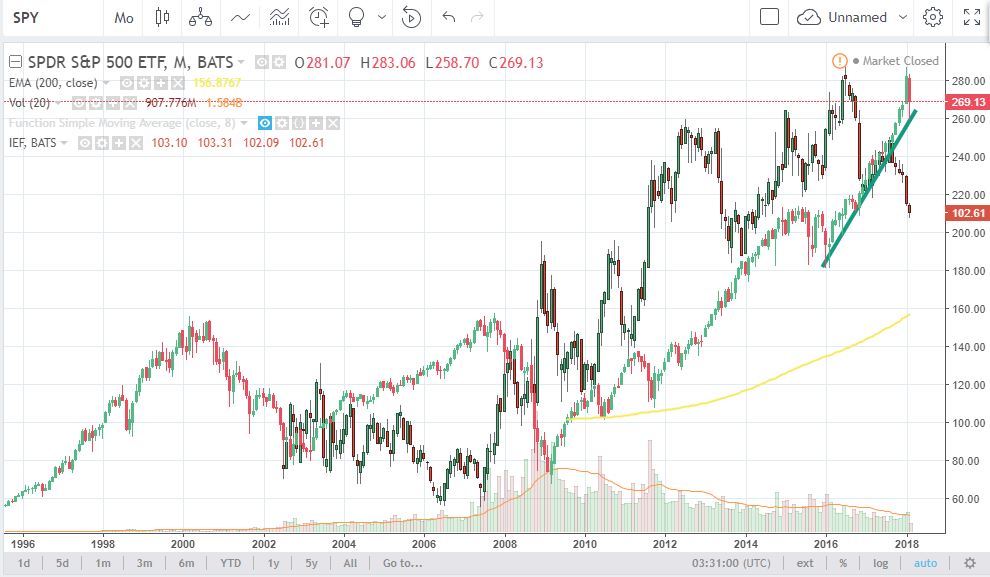
Relationship between S&P and IEF 7 years Treasury ETF
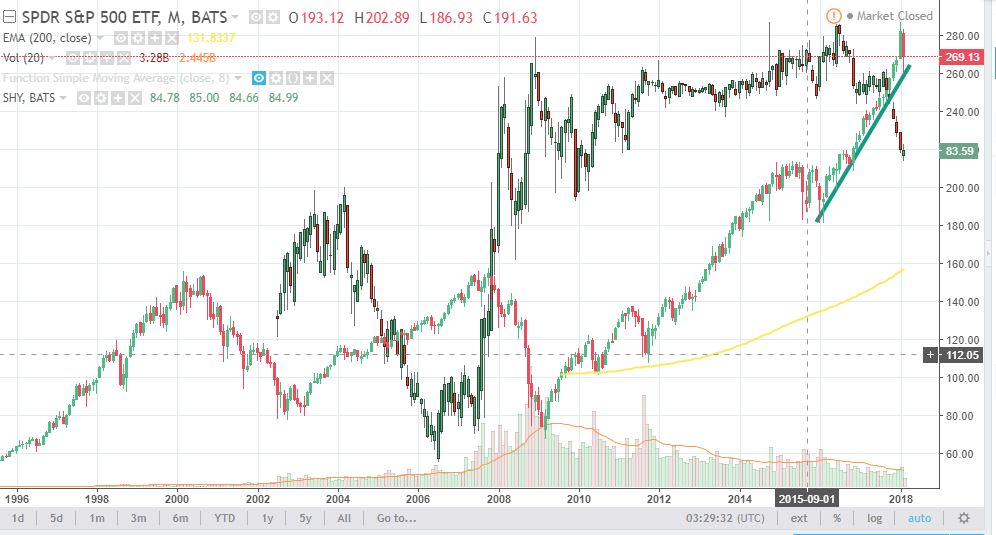
Relationship between S&P and SHY 3 years Treasury ETF


The extra yield on Treasury investors are looking for to compensate for inflation uncertainty is extremely low. The other risk is Fed, quantitative easing has only just been put into reverse mode, the 4 trillion is only 3 billion smaller. As the balance sheet shrinks, the pressure is put on bond yields and downward pressure on stock prices. I believe inflation will be low for 2018, economy will improve further but higher bond yield will definitely happen.

Bond Bear Market
Legendary value investor Bill Miller has an optimistic view on equity market. He strongly believes that bond bull market has come to an end and investors are cashing out from bond market, shifting to equity market. He said,"I believe that if rates rise in 2018, taking the 10 year treasury above 3 percent, that will propel stocks significantly higher, as money exits bond funds for only the second year in the past ten. Bonds, in my opinion, have entered a bear market, but one that is likely to be benign for the next year or so."

The market had already showed a strong rally in 2017 and a strong start in 2018. The improvement in corporate earnings, global recovery, tax reform, improvement in fundamental factors and further stimulus to economy drove the market prices up. According to Bill Miller, investors are shifting from bond market to stocks which will further reinforce the stock price's movement. My guess is rising bond yield condition will further depress bond prices (TLT and IEF). The thesis is the bull run for bond market may come to an end.

Warren Buffet felt that stocks have gotten less attractive but they are still very highly attractive compared to bonds because interest rates are very low. With rising valuations, it is not like buying shares after the 2008 financial crisis which is like shooting fish in a barrel. Nonetheless, I felt that rather than seating and waiting for the Treasury ETFs to appreciate, it will be better to switch out to stocks and ride this last wave.

JC Options Fund Update 27 Jan 2018


Just now, I experience a moment of fear. I remember recently in 2017, I experienced a fearful incident. I took the staircase in International Plaza on the 26th floor to 25th floor then I tried to open the door but it was locked from inside. I started to descend to the next level and try to open the door. Again it was locked. Then I tried the next floor and the next one. Fear started to creep in when I went to 20th floor. I was flustered and worried what if nobody realized that I am missing as it was a Sunday. Then I calm myself, took a breather and continue to walk downstairs and finally the door was able to open on the 6th floor which leads to the car park.

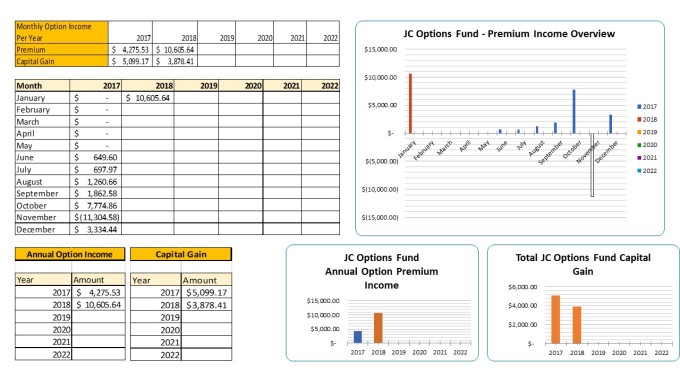
My fear earlier was when I did a cut loss on all my TLT and IEF options. It was very painful and scary. I just frantically pressed the right click button on the mouse and execute the close position order. I will explain my rationale why I need to shift out from bonds in another post. For capital loss, it was - USD 4,304.95 and premium loss was - USD 433.88. OUCH! To justify for the losses, I chased after a volatile stock AAPL and sell put on it to gain the premium of USD 9,189.54. I think it is going to be shitty as 1st February after market close, the earnings is going to be released. Yes, I did not check the earnings date again. This is the type of situation which you can only pray that the earnings is good and you get to keep the differences and free up your capital. Worst case scenario, it is going to be a thick white bar downwards like the month of November 2017 as shown in the above figure. If it happens, the thick white bar is going to be very scary.

Sunday, 21 January 2018

Hedging with Options

Hedging enables the fund manager to transfer part of the risk with holding a position in the underlying instrument from one party to another. Options act like an insurance policy. There is a cost with hedging. It involves initial cash or opportunity costs involved such as potential profits and additional risk exposure in certain scenario.

Using Options to Protect an Equity Portfolio
Buying protective puts is the most obvious way to hedge a portfolio.  The investor selects the option with a specific expiry date and strike price, the level of risk assumed and the cost (premium paid) incurred is known.

Selling Covered Call is selling options against long position. This strategy does not offer limited downside risk compared to buying protective puts. Income (premium) generated from selling call options can mitigate a decline in the portfolio value, but the premium received may not provide much buffer when the stock/underlying asset's price falls sharply in the market. I have limited my gains when I previously sold call on SKX at $26, when the results came out, the price went up to $30 and as of 21st Jan 18, it is about $39. Selling Call can limit your upside and provide limited downside. If the stock price is neutral and does not move much, it can enhance your yield or premium can be considered as an income.

Zero-Cost Options
If an investor wants to hedge with very limited risk exposure, he can do so by simply purchasing an option. If he also wants to avoid putting up cash associated with such a strategy, he can achieve this by been cash neutral through simultaneously combining the purchase of the option with a sale of another option.

This is known as a zero-cost dollar, by buying protective put and writing an out of money covered call. The call option is sold with a strike price where the premium received is equal to the premium paid to buy the put. This zero dollar collar is used to protect existing long stock positions with little or no cost.

Friday, 19 January 2018

JC Options Fund - January 2018 Update


I have divided the tabulations into two sections for JC Options Fund, the first leg will be Annual Options Income and the second leg will be from Capital Gain. For January 2018, I have used Diagonal Call on three counters to achieve the capital gain. For the monthly options premium, I have achieved USD 1,865 which is approximately 3% yield per month based on my initial injected capital into JC Options Fund.

I have taken a large position in TLT ETF both in terms of Diagonal Call and sell put. My take is for 2018, the yield should not increase fast enough and there is still some room for the price to appreciate. I am trying to use GLD and TLT to smooth the deviation of the entire portfolio's performance. 

Figure 1 - JC Options Fund Overview and Performance
Overall, I am still experimenting with how options can be used to enhance yield and hedge against existing positions in JC Fund. When I hedge an existing position by buying an insurance through buy put, I will be reducing my overall performance.

I have tried another strategy which is selling put on a counter, with the premium gain, I will use it to do a buy LEAP call on GLD or TLT.


Saturday, 16 December 2017

JC Options Fund - December 2017 update

I am using options to create another stream of income through premium income and capital gain using buy call.

It has been a roller coaster trying to sell put SP 30 on BZUN, I sold 5 put when it first started to drop and another 5 put to reach average premium of 1.2 per contract. The share price drop below 30, reaching 28 at one point. When the share price comes back up on 13th December, I close the trade and pocket USD 1,050. 

I also sell put 5 contract on Chinese Tinder :) 

My target is to maintain USD 2k per month and I am satisfied. 

JC Fund 2018
Dividend Income (Passive) say SGD 3k per month (conservative)
Option Income (Active) USD 2k x 1.35 = SGD 2.7k per month
Rental Income (Passive) SGD 0.5k per month
Planning to start - Tuition Income (Active) SGD 1k per month
Target Additional Income SGD 7.2k

I do not think my day job can last for much longer. There will be some turbulence in Q1 or Q2 2018. 

Wednesday, 15 November 2017

JC Options Fund 6th Month Results

Fear creeps in and I close all the trades when I saw the earning reports. I think trading is very different from investing. I should not mix this two together. Option is a tool to enhance your return from investing but when it is used wrongly because of greed then it can cut you like this. 

This month losses have wiped out all the gain and set me in red.

Lesson learnt - do not be greedy and go back to the rules and fundamental of investing. 

I will not chase after premium blindly by selling put and forget portfolio sizing. I should deploy diagonal call strategy or Bull Put Spread as well. 

Let's start this from ground zero.

30/11/2017

I manage to make back a 2k on some sell put on TLT and IEF, I also made two other buy calls:

1. Buy 10 JD.com leap call 18 Jan 19 SP 30 - Average Premium 10.8
2. Sell 10 BZUN 15 Dec 17 SP 30 - Average Premium 1.2 


Tuesday, 31 October 2017

Unwanted Children - UAA and AMD

Every month end I will update my spreadsheet on status of our investment portfolio and cash equivalent. There are a lot of higher high for my core portfolio. I thought JC Option Fund can outperform as well but I have stepped onto not one but two time bombs.


 This will wiped out USD 500 plus of the profit as I sell put 5 contracts at 12.


Did you see the little gap down red cross at USD 14.13? UAA was downgraded and earnings expectation is lower than estimate. This one is going to wipe out USD 2k profit. This happens when you don't follow the rules, greed gets the better of you. My Sketchers got a 30% increase in share price but gain was capped by 3 stupid sell call options. 

I am starting to redeploy in Hong Kong shares.

I reached out to Thomas of 15 Hours Work Week and he shared with me on his journey from being an employee to self employed. I am simply unhappy @ work. I need to map out a plan to become self employed.

2/11/2017

I closed UAA put option and locked in USD 4,100 of losses. I did not wish to roll this because the fundamental of the stock has deteriorated. The branding is diluted. I learnt an important lesson in options, you need to spend time to study the underlying derivative. If you ask me whether I have conduct fundamental analysis on UAA in the first place? No.

Where is my trade diary? I need to start recording my trades.

Sunday, 29 October 2017

Opportunity Cost of an Employee

My mentor who is one of the top remisier boast to me that his net worth will be increased by SGD 1 million this year. His method is pure value investing only. Sometimes, he will use CFD to short a few counters. His CFD trades are for "kopi" money or just for fun. Maybe by next year, he will cross the SGD 4 million mark. He is 36 years old only.

I need to compare again, he can spend bulk of his time to research on undervalued stocks. He has a war chest of investing ideas and portfolio of stocks from the best companies spanning from Europe, Japan, Hong Kong, USA and Singapore. 

He is setting out to start his own hedge fund and wish me all the best in my investing journey. As I am not an Accredited Investor in 2017 but I believe I will meet the requirement by 2018. Nevertheless, I will choose not to invest in his hedge fund because I believe in DIY. Nobody is more concerned of your finances than you. If I invest my own money and I lose it, it is solely my responsibility. I won't want to leave my money in an active managed fund without having the control and not knowing what is the money been used for. 

I was on a plane when I draft this. I started reading financial reports after my boss return to his seat. I realize reading financial report is a very time consuming activity in order to understand the transaction history, growth story, and background of the business. It will probably take 1 full day to digest one single company's financial reports and conduct the company's SWOT analysis. In fact, there are a lot tools which I learn from my MBA that can be applied on stock analysis. 


I felt that there are a lot of investment opportunities are lost because of working as an employee. Every working day, I spend 3 hours commuting to and fro (I will read on MRT or take a nap), another 8 hours in meetings, toilets, lunch and some work, another 2-3 hours at night trying to wrap up my tasks for the day. Probably left with another 1-1.5 hrs at midnight to read a book or a financial report. Due to the lack of time, when I chance upon a good company and the stock price had just doubled in the last 3 months, I will feel upset.  
  
If my option income can achieve at SGD 10k per month, I will become a full time investor cum options trader. My testing model will be SGD 10k per month for 3 months consecutively and sustainability test after a major share price correction. It is no good if all the profits are wiped out after a crisis and back to square one.
  • 3 consecutive months of SGD 10k options income
  • Survive and sustain 1 crisis
 

Saturday, 14 October 2017

JC Options Fund 5th Month Results

This month result is slightly special as I have previously recognized wrongly in terms of the expiry date. Some of my older trades expired on 13th October 2017 and there are a few other trades which will expire on 20th October 2017. Options trading is creating another source of income for us but it is still considered an active income as I need to do some work on the last day of option expiry. 

See below Figure for an update of the options income. Past performance does not represent future performance and profit can be easily wiped out if I am greedy.


I foresee that October Options Income can be increased after I close the trades expiring on 20th October. With the free up money, I can deploy to other trades when there is an opportunity.  

Thursday, 21 September 2017

JC Options Fund 4th Month Results

This game is getting addictive and dangerous. Just recently, I tried to execute a repair strategy and I press the wrong button. End up, I was stuck with a lousy position of 4 sell put on UAA. 

Just now, I was chasing after FSLR premium, I have a bad vibe about this. I think greed is going to come back to bite me soon.

I bought a LEAP call on IEF and intend to buy LEAP call on TLT, diversifying into bonds ETFs.  

Saturday, 19 August 2017

End of 2nd month JC Options Fund

This is painful. In addition to the above picture, I close my LB option and roll over to next month. Overall, it is a net loss, wiping out all the gains (plus more losses) in my 2nd month of options. 

I have a list of lessons learnt from this month. You can find them here from Ally website, I can relate to quite a few of them. I will learn from my mistakes, let me think through my strategies. I read Ray Dalio's Principles and I learn that pain is good. It helps you to grow up.

https://www.ally.com/investing/options/top-10-option-trading-mistakes/

Also a lot of my friends took a hit because of FL (Foot Locker), don't give up, there is bound to be some bad calls, close it and move on. Sometimes I make money, sometimes I lose money, as long as the good calls are slightly more than the bad ones, I end up making money.

In addition, I bought a total of 300 shares of L Brands. I took a quick look and overall insider shares acquisition is increasing in 2017.

LB ticks all the boxes. I have intention to build up to 1000 shares of LB only, my new rule of thumb is keep all portfolio at about 5% of entire portfolio.

L Brand owns the following brands:
Bath & Body Works - personal care, soaps, sanitizers and home fragrance products. 1700 North American stores, Bath & Body Works has 80 stores in more than 20 other countries operating under franchise, license and wholesale arrangements
PINK- college woman and campus life 
La Senza - Fun flirty lingerie brand celebrating young, sexy and value-oriented customers
Henri Bendel

Victoria's Secrets - signature bras, panties and sleepwear, popular fragrances, body care and athletic line, Victoria Sport
Victoria's Secret Beauty and Accessories - This smaller concept started with airport travelers, focuses on award winning fragrances, body care and accessories.


Company Background
L Brands is an international company that sells lingerie, personal care and beauty products, apparel and accessories.  The company operates more than 3,000 company-owned specialty stores in the United States,Canada, the United Kingdom and Greater China, and its brands are sold in more than 700  franchised locations worldwide. 


Market Research
Intimate apparel industry is a $29 billion global market 
The largest customer base is the 45 to 54-year-old group followed by the 25 to 34-year-old group
Victoria's Secret's PINK brand dominates the growing teen market with sales of roughly 1billion.

Strength - Economic Moat
Segment Leader, sell an experience, top of mind => Branding
Sticky to the product - the products help customers feel sexy, bold and powerful, entice customers to pamper and indulge themselves and enjoy everyday lives.
Economies of scale - capitalize on production, logistics supply chain and combined with technologies to achieve cost efficiency
Enhancement of branding - has highest number of best models and photographers to advertise for their products, organize annual fashion shows to improve brand image
International presence - global footprint (in Middle East and Africa)
Ecommerce is gaining traction - strong online sales 

Weakness
The dress can be worn only in bars and movies but in real life there are few people who wish to wear such dresses
Limited market in Asian market

Opportunities
Strengthen online e-commerce stores
Open key strategic stores worldwide
Market to Men through a new brand

Threats
Competitors offer similar products - differentiation is minimum in terms of functionality
Economic downturn will affect sales 
A lot of competitors 


Risk Assessment


Competitors' Analysis
The intimate apparel market is also fragmented with Hanes which has sales of $1 billion followed by Fruit of the Loom, Jockey and Maidenform
Sales Per Square Feet & Sales per Store

Sales per square feet per store shows a slight deterioration.

Sales per store shows slight deterioration. In 2017, the sales level is dropping due to its change in business direction.

Another possible hit on L Brands' brands are the high rental cost and competition from e-commerce. Alibaba's Aliexpress, Wish and Amazon are driving prices down. E-commerce will deteriorate L Brands' business as the branding is not as strong as those branded stuff such as LV, Hermes, Burberry, Prada, etc.

Wednesday, 9 August 2017

Sell Put and Sell Call Option Strategies

Selling a Put

Key Factors
  1. Extremely highly implied volatility (the higher, the better)
  2. There is an identifiable support level
  3. You want to own the underlying security

Once this trade is entered, one of three outcome will occur:
  1. The stock will remain above the strike price of the put option and the option will expire worthless. In this case the writer of the option keeps the entire premium he or she originally collected when the option was written.
  2. The price of the stock will fall below the strike price of the option written, the option will be exercised, and the writer of the option will be assigned (ie, required to purchase 100 shares of stock at the strike price).
  3. The writer of the put option will buy back the option before outcome 1 or 2 occurs.

This strategy is used by investors who are interested in accumulating shares of stock in a particular company but who for one reason or another are not willing to commit to buying the shares at the moment. It is best suited for value investors who typically accumulate a position of meaningful size in a stock after the stock declines in price and are willing to hold the position for a reasonably long period. The most important consideration is whether you want to own the stock when you execute this trade. If the answer is no or if you are not really sure, you should not use this strategy. To understand why, let's consider the primary benefit of this strategy and the worst case scenario. Investors who use this strategy do so in an effort to acquire stock at a price below the current market price. Here is how that happens.

Say a stock is trading at a price of $85 per share. At the same time the 80 strike price put option is trading at a price of $3. You could buy the stock at $85 per share or you could write a put option with a strike price of 80 and collect a premium of 3 points or $300.  If you buy 100 shares of stock at $85 per share and it declines to $77 per share, you will lose $800. If you had written a put option at a strike price of 80 for 3 points and the stock declines to $77 per share, you would be at break even. This is the benefit.
 
The disadvantages are:
  1. If the stock rallies sharply, you will not participate in that rally beyond the option premium you collected.
  2. If the stock falls sharply, you will have significant downside risk.

You should use this strategy only after you have analyzed the prospects for the underlying company and have consciously decided that you are definitely willing to buy the stock. Use this strategy only when volatility is high to maximize the premium you receive for the option you write.

One method for managing stock position if assigned when the stock is put to us and its price continues to decline. You can hold the position until the option expires or the stock is put to you. If the stock is put to you, you can place a stop loss at the strike price less the premium. Or you can sell call once it is put to you.

Writing a Covered Call/Sell Call

Key Factors:
  1. You have some reason to expect the underlying to pause. 
  2. Option volatility is high
  3. You can take advantage of time decay by selling out-of-the money options
Option offers to long term investors the ability to hedge existing positions in an underlying security. If you are holding position in a stock and wants to hedge that position, options are often the easiest and most effective alternative for achieving this objective. A covered call write involves writing a call option against a long position in the underlying security.

Covered call is most commonly misused option strategy. Most traders never consider writing covered calls, once they do, they rarely stop to consider the reward and risk ramifications. At best, writing a covered call allows income generation from an existing position and to obtain a little downside protection. At worst, this strategy limits your upside potential and provides only a limited amount of downside protection. There are a number of different ways to use this strategy. For instance, some traders buy a stock they consider oversold and simultaneously write a call option against that position. This is referred to as a buy-write and is employed by an investor who is focused on total return.  Or you can write options against stocks you already held. Use this strategy after a security you are holding has experienced a significant rally and you expect it to consolidate or decline in the near future.

In sum, if a security you are holding has experienced a sharp advance in price and implied volatility rises to a very high level, thus inflating the amount of premium available to option writers, you may benefit from writing a covered call.

In deciding how to manage a covered call position, you must address two risks:

  1. The first risk is that the stock may fall by more than the amount received when the call option was written. Once that happens, the covered call provides no additional protection, so the potential loss becomes unlimited. Technically the risk is not unlimited since the stock can only go to zero.
  2. The second risk is that the stock may rally sharply, causing the option that we wrote to trade in the money. Once the option trades in the money, there is a possibility that the holder of the option may exercise the option and our stock will be called away. If we do not want to give up our stock position, we must plan to buy back the call if the stock price rises.

Before writing a covered call, you must decide what you will do if the stock drops sharply or rallies sharply. If the stock drops sharply, your choices are these:
  • Sell the stock, buy back the call, and exit the trade completely to avoid additional losses.
  • Hold on both positions and hope the stock bounces back
  • Roll down. Rolling down involves buying back the call option written initially and selling a new call option with a lower strike price.

If stock rallies sharply, you may do one of three things:
  1. Let the stock be called away
  2. Buy back the call option you wrote (possibly incurring losses)
  3. Buy back the call option you wrote and sell another further out of the money call option
There is one way around the limited profit potential conundrum that offers the benefits of covered call writing while allowing you to participate in favourable movement by the underlying: avoid writing covered calls in a 1:1 ratio. You need to have more than 1 contract to do this. If you are holding 1000 shares of stock, you might consider writing 8 call options instead of 10. By doing so, you will still have option premium which offers some downside protection and opportunity to earn extra income.


Thursday, 3 August 2017

JC Fund 2nd month options trade

Recently, things are just not going smoothly. I believe the first month was just sheer luck and now I am trying to figure out things. I was reading up more on options as I want to go deep into the subject. 

There are a lot of techniques and skills which I am trying to learn. Option can be useful in mitigating risk and help to hedge against position, it can also help to maximise your gain if used correctly. Another thing I learn is not just simply go for premium and did not understand the volatility, the earnings reporting period and deterioration of the fundamental. It is apparent that I let greed get the better of me.

It is not too late but just the start. I saw a Facebook advertisement of my army friend. He has grown his portfolio from USD 5k to USD 120k over the last 7 years and has declare that he achieved financial freedom, quit his corporate life and become a full time options trainer. I respect him for two things, 1) he has the guts to call it a day and run his own business whereas I am still happy that someone is paying me at the end of every month 2) he is disciplined enough to pursue his dreams and keep moving forward. These two factors won my respect. I think I should my dreams sooner rather than later.

Memos from Howard Marks Look for "There they go again"

I agree that valuation is getting higher and not much (very few) undervalued stocks are available. 

I just borrowed this book "The Tao of Charlie Munger" and I realised that many years ago, Charlie was fully invested when he experienced the crash whereas Warren had placed his money with the Treasuries. Charlie waited for a while for the stock prices to recover whereas Warren pumped in and bought all the underpriced companies. I think by end of this year, I need to complete my rebalancing of stocks. I have sold some of my SG and US counters. I am thinking of standing by a pot of $200k in cash or in bonds ETF. 

13/8/2017 
Recently, the stock market took a plunge and it is painful for Options Fund. Initially, it was a loss at US$100, then the loss widens to US$600. It has been a long while since I cut loss as I seldom trade these few days.

I was too greedy and just focus on the premium without understanding the risk level involved.


Thursday, 27 July 2017

JC Fund + (JC Options Fund 2nd month review) - mistakes mistakes and more mistakes

As you can see Corning sell put option represents a high chance that it will be exercised. I sold put at 31 and as I am typing, the price has dipped to 29+. 

Lesson 1 - Never sell put/call into the earnings session unless I am very confident of the direction where it is heading. Even so, I should try to avoid at all cost because the stock price becomes very volatile.

Lesson 2 - I need to do more homework on the individual business.

Lesson 3 - I should create a shopping list just for options - income generating purpose only.

There is a high probability I need to standby some funds for Corning and UAA (why did I buy UAA and not UA?!). 

Another mistake I made this week is to sell out half of HPH Trust USD because the share price recovered to USD 0.46 after it ex-dividend. You can call it a mistake but I want to rebalance my portfolio and shift more of my funds into high ROE and ROIC companies. 

Well, I am going to be patient (as advised by a friend Mr Chia F.L. for me to take lesser bats like Warren Buffet) and hold some cash for a better opportunity before I take position. 

Sunday, 23 July 2017

JC Options Fund 1st month review

There is some luck element involved here as we managed to achieve close to 90% profit for most of the options with very minimum risk level of them been exercised for the first month of our options' journey. If we have bought call options, the profit level will be higher.

Nonetheless, this is a good start or beginner's luck. I have already rolled out two options which are due on 18th August. 

Monday, 17 July 2017

Managing Risk with Options

Risk levels are different for calls and for puts on the short side. The timing of a strategy and choices made determine the actual market risks to which they are exposed. For example, a basic covered call strategy is deemed "safe" or conservative. However, if the basis of the stock is $39 and a covered call is opened with a 35 strike and with premium of only one point, the risk is considerable.Exercise creates an automatic net capital loss of $300 (four points between strike and the higher basis, minus one point for the option premium received). This is clearly high risk strategy, notably because the premium is small compared to the negative point spread between strike and basis.

A covered call strategy is likely to be high risk if the underlying is a highly volatile company. If the market value declines rapidly, it will result in a paper loss. For example, I bought 100 shares at $39 and sold a covered call with a 40 strike, receiving a premium of 5. In this case, the breakeven on the downside is $34 ($39 basis minus 5 points received for selling the option). If the stock declines below that level, the net outcome is in the loss. On the upside, exercise produces a profit of $600 ($500 received for selling the call, plus one point capital gain). So this situation presents a limited profit on the upside with potentially unlimited loss on the downside. Covered calls do not guarantee profits.

Risk even for uncovered calls, may be quite low. Focus on calls expiring within a month or less reduces risk due to time decay during option's final month. From there, uncovered calls can be selected based on a combined analysis of implied volatility and probability. The uncovered call opened without concern for time or proximity but only to augment the premium level is far more likely to represent a very high risk strategy.

The uncovered put contains much less risk than the uncovered call. The short put is less risky because risk are finite. An underlying price can only fall so far, at first glance drops to zero but the more specific risk level should be dropped from strike of the put and the tangible book value per share minus the premium received for selling the put.

For short spreads and straddles, the maximum loss is the ITM exercise level, minus the premium received for opening the position. Maximum gain is limited to the premium received and this is realized only when options end up OTM at ATM, or are closed prior to expiration at a profit.

Another key risk which I will like to highlight is Lost Opportunity Risk which comes in two varieties. First is the opportunity to take up positions that is lost when your entire equity and margin are at maximum. If your portfolio is full of paper loss, you lose opportunities because you are unable to move when those opportunities arise. Second definition relates to covered call writing, if the underlying price rises far above the strike, the short call is exercised and the trade loses the opportunity that would have resulted by just owning the underlying. 

Sunday, 16 July 2017

JC Options Fund 15072017

I sold another put while I was in Taiwan. I gathered from my Taiwanese client that China is an unstoppable force in terms of economic strength. I will prefer to buy a Call on this stock FXI but let me practice my options first.

In an ideal world, I can boost my cashflow through the use of options to achieve financial freedom earlier. Then I will just continue to grow my existing portfolio while using cashflow from options to pay for daily expenses.

By 2019, if everything goes smoothly, we should be able to achieve our quest. Then I will let my wife continue to work for another 2-3 years and she can focus on her coaching business. 

I want to contribute back to society and help our fellow Singaporeans to be more financially savvy, encouraging them to start investing and do their financial planning earlier rather than late. I have seen how our Taiwanese counterpart are financially savvy and more entrepreneurial than us because of media and geopolitical reasons. I think there is an increasing number of financial bloggers which is good for young people to learn more about financial planning and investment. I think it should be compulsory for schools to teach about finance and investment (not textbook stuff like efficient market hypothesis, beta, CAPM model but practical ones). 

The world is going to be very different 20 years from now, AI is coming in a very big way, there will be a lot of disruptions to normal businesses. We need to get ready for this. 


Thursday, 13 July 2017

JC Options Fund 13072017

I sold put on L Brands last night. This stock is still kind of pricey but I don't mind having it in my portfolio if been exercised. 


Recently I was very busy with work. There are lots of changes which I will like to update later on. Time to hit the gym before going for more meetings in Taiwan.

Latest Post

We have moved!

We have moved to a new website: www.jcprojectfreedom.com Visit us there!